0800 30 13 77
 0800 30 13 77
 En
En

 Back
BackWhat is better to choose – an oil or oil-free compressor?
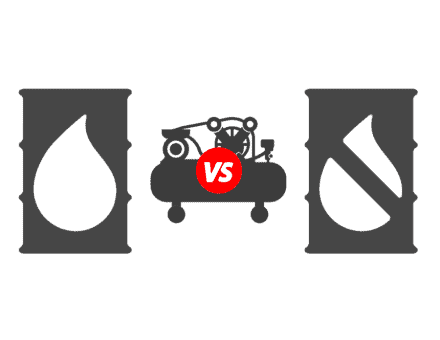
On the Internet, you can find a fairly common question from people choosing pneumatic equipment: “Which compressor is better – oil or oil-free?” This is a fairly common question when choosing compressor equipment.
This approach to the problem of equipment selection does not take into account the main determining factors. To begin with, a compressor is selected according to a number of technical parameters, such as the required compressed air volume (capacity/consumption), operating pressure, continuous operation time, control system, energy efficiency, and, of course, the required purity of compressed air in terms of oil, moisture, and solids.
Two compressors with similar performance parameters can differ dramatically in terms of operating modes, compressed air purity, and cost. The question arises – how correct is it to compare them?
Is it possible to find the perfect compromise when selecting equipment, choosing from oil-free and oil-filled compressors?
Advantages and disadvantages of oil compressors
In compressor operation, oil performs several useful functions at once: it reduces friction and, consequently, wear of moving parts; it reduces heat and improves heat dissipation.
All this allows for long continuous operation of the equipment and a long service life, with proper and timely maintenance. The main rule is to use only the oil recommended by the manufacturer. Ordinary transmission or motor oil for automotive equipment is not suitable for such purposes.
The advantages of choosing an oil-filled compressor also include a huge range of equipment from portable models to powerful industrial high-pressure compressors.
The main disadvantage of such compressors is that the compressed air contains oil particles, which makes it impossible to use it in many areas that require “cleanliness” for the technical process.
Advantages and disadvantages of oil-free compressors
As the name implies, oil-free compressors do not lubricate the working area in contact with the compressed air. This, in turn, causes increased heating and requires a more sophisticated cooling system for long-term operation of the unit. More complex air and water cooling systems are used to remove heat from the working area. In addition, the compressor design is designed to use fewer moving parts that require lubrication.
- For Pet Master oil-free reciprocating compressors, Dalgakiran engineers have developed a multi-stage cooling system with an air and water circuit.
- Dalgakiran EAGLE oil-free screw compressors use an air cooling system with a steel and aluminum heat exchanger.
- Dalgakiran DS scroll compressors are designed with a built-in fan to provide sufficient airflow for the working area and performance.
As you can see from the Dalgakiran compressor range, there are different types of oil-free compressors available. It is important to note that it is incorrect to directly compare oil and oil-free compressors of different types. In addition, the differences between reciprocating, scroll and screw compressors are very different in design.
The main advantage of oil-free compressor equipment is clean, oil-free air. There are quite a few areas where conventional oil compressors simply cannot be used, including the automotive industry:
- production of polymer products, including food packaging;
- production of medicines;
- Dentistry;
- painting lines.
Other advantages of oil-free machines include low noise and vibration levels due to the design with fewer moving parts and low maintenance, as no oil changes are required.
Among the disadvantages of oil-free compressors:
- Relatively high price – the use of parts made with greater precision from more wear-resistant materials increases the cost of the compressor. With equal performance, an oil-free compressor will cost more than an oil-filled one.
- Shorter service life. No matter how precisely a screw or piston unit is made, friction cannot be completely avoided. Moreover, without oil, heat is more difficult to remove. Equipment wear and tear is higher, and the service life is shorter.
- Power limitations. The absence of direct contact between the compression elements and more complex heat removal during operation imposes power limitations. Implementation of a system with several stages of compression and cooling with several circuits can solve this problem only at the cost of a significant increase in the cost of equipment.
Air and oil filters and separators for compressors
Oil-free compressors have their limitations in terms of performance and operating modes. A situation arises when, on the one hand, the business requires the capabilities of an oil compressor, and on the other hand, the technological process allows the use of only clean compressed air. In this case, an alternative is to install main compressed air filters. Do not assume that the use of filters is a compromise to the detriment of compressed air quality for the sake of economy.
Compressed air filters from Dalgakiran are now used with compressors not only in the food, chemical, and pharmaceutical industries, but also in hospitals and laboratories.
Despite this, there is an opinion that the filter cannot be considered a reliable solution, as it can fail prematurely. Yes, any equipment can fail, but in industries where the use of oil compressors is strictly prohibited, they are simply not used. And where there are standards for the minimum content of oil particles in the air, the appropriate equipment is selected.
A simple example is that most spray guns allow an oil content in the air of up to 0.01 mg/m3 (on average), while Dalgakiran GO series filters cut off oil suspensions with a concentration of up to 0.003 mg/m3. The condition of the filters themselves is checked by their own pressure indicator and color indication of the filter media. And for industrial solutions, a complete solution is supplied. In addition to the filters themselves, it includes equipment for regulating air temperature and humidity, remote control and condition monitoring.
Thus, Dalgakiran Compressor Ukraine can offer your business a technical solution that combines the strengths of an oil and oil-free compressor. The largest network of service centers in Ukraine allows us to take on the task of timely maintenance of compressor equipment, including the replacement of main filters.