Today, energy independence has evolved from an ambitious goal into a basic necessity for thousands of families and businesses. Solar panels lay the energy foundation for such autonomy. The renewable energy market has taken a huge leap forward, so today’s photovoltaic modules deliver high efficiency not only under the direct summer sun, but also on overcast or cool days.
In this article, we’ll discuss how to choose the right solar panels for your needs, which technical specifications to look out for before buying, and how to ensure your system operates at maximum efficiency and has a long service life.
Types of solar panels and their features
Before buying solar panels, it is worth understanding the different types available, as the type of crystal determines not only the system’s efficiency but also the final price of the solar panels. Currently, two main types of photovoltaic modules dominate the market:
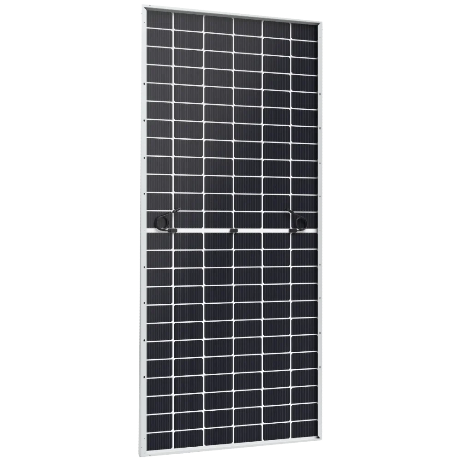
Monocrystalline panels. They are easily recognisable by their characteristic uniform dark, almost black colour. These modules are made from the purest synthetic silicon. They have the highest efficiency rating – ranging from 21% to 23.5%. This means they generate the maximum amount of energy per square metre of surface area. If you have limited space on your roof, monocrystalline panels are the best choice, although they are slightly more expensive.
Polycrystalline panels. These modules have a blue tinge and a non-uniform structure with a pattern resembling ice crystals. They are simpler to manufacture, which is why their price is significantly lower. However, their efficiency is lower — around 13–16 per cent. They are suitable for large industrial sites or areas where there are no restrictions on the space available for installation.
Recently, bifacial technology and half-cell or TOPCon cell architectures have gained popularity. They allow the capture not only of direct sunlight but also of rays reflected from the ground or snow, significantly increasing the output of the entire plant without increasing its physical dimensions.
How to choose a solar panel?
When you’re ready to order equipment, the vast array of brands and specifications can be overwhelming. However, if you break the selection process down into logical steps, finding the ideal option will be much easier. You need to focus on a few key factors.
Manufacturer.
Firstly, pay attention to the manufacturer’s reputation. Experts advise choosing companies from the international Tier 1 ranking. These are major global giants that invest millions in quality control and guarantee the stable operation of their equipment for 20–25 years.
The Tier 1 ranking is updated quarterly and reflects only the manufacturer’s financial stability (that they won’t go bankrupt tomorrow), rather than an assessment of a specific model. When making your choice, always check the type of warranty in the technical specifications: there should be two types — a product warranty (preferably 12–15 years) and a linear power warranty (guaranteeing at least 80–85 per cent of the power output after 25 years).
Power.
Secondly, work out the power you need. To do this, you need to know how many kilowatt-hours your home or commercial property consumes. The power output of a single modern panel can range from 400 W to 600+ W. Accordingly, to assemble a 10 kW home solar system, you will need fewer high-power modules, which will save space on the roof and reduce the cost of mounting brackets.
Conditions.
Thirdly, consider the conditions in which the system will operate. If your roof is periodically shaded by trees or neighbouring buildings, look for models featuring Split-Cell (Half-Cell) technology. In these, the top and bottom sections operate independently: if a shadow falls on the bottom of the panel, the top half will continue to generate electricity at full capacity. Of course, these solar panels will cost more, but this investment will quickly pay for itself thanks to higher power output.
If shading is severe and lasts for several hours a day, even Half-Cell technology won’t save the entire system, as a single shaded panel in a string will drag down the output of all the others. In such cases, instead of a standard inverter, it is worth using micro-inverters or adding power optimisers to the shaded modules. These will allow each panel to operate independently.
The benefits of installing solar panels
The decision to buy solar panels is not simply a matter of following the latest fashions or environmental trends. It is a pragmatic and well-calculated step that brings real benefits to the owner from the very first day after the system is connected.
Savings on electricity
This is arguably the most tangible benefit. Generating your own electricity allows you to almost entirely cover the daily needs of your household or office. As electricity tariffs for households and commercial businesses tend to rise steadily, every kilowatt generated by your own roof is money saved that stays in your budget. On average, a high-quality home solar system pays for itself in just 3.5–5 years, after which you receive free energy.
Environmental sustainability
Switching to renewable energy is your tangible contribution to preserving nature. Unlike thermal power stations, solar panels do not burn fuel, nor do they pollute the air with heavy metals or greenhouse gases. They operate completely silently and are entirely safe for the environment, both during operation and after disposal.
Independence from the mains grid
By combining solar photovoltaic modules with specialised inverters and energy storage systems (batteries), you create an off-grid system. Power cuts, planned or emergency disconnections from the mains grid, and power line failures due to bad weather — none of these are a problem anymore. Your home will continue to function as normal: fridges, the internet, water pumps and heating systems will all keep running.
Maintenance and care
Many buyers are put off by the idea that such a complex system will require constant and demanding maintenance. We’re keen to reassure you: a solar power system is one of the easiest engineering systems to maintain, as the panels themselves contain no moving parts that could wear out or break quickly.
All maintenance of the photovoltaic modules boils down to a few basic rules:
Cleaning off dirt. Dust, dry leaves, bird droppings or plant pollen create a thin film that blocks the sun’s rays and reduces generation efficiency (sometimes by 5–10 per cent). Usually, a normal rain shower is perfectly adequate for removing most dirt. However, once or twice a year (especially during the dry summer months), the panels should be hosed down with water. This should be done in the morning or evening, when the glass is not heated by the sun, to avoid micro-cracks caused by sudden temperature changes.
Shade monitoring. Trees grow around the house, and over time their branches may begin to block the system from the sun. Regularly trim any foliage that interferes with the system’s operation.
Technical inspection. Once a year, it is worth calling in a specialist to check the reliability of the mountings, the integrity of the cable insulation and the operation of the inverter. This ensures that the system will operate at its full potential without the risk of short circuits.
If you’ve decided to invest in your own energy independence, remember: the key is to choose reliable equipment and entrust the installation to professionals. Then, sunlight will work to your advantage, saving you money and ensuring your comfort for many decades to come.
 0800 30 13 77
 0800 30 13 77
 En
En







Відгуків немає, поки що.