0800 30 13 77
 0800 30 13 77
 En
En

 Back
BackChillers with water-cooled condenser
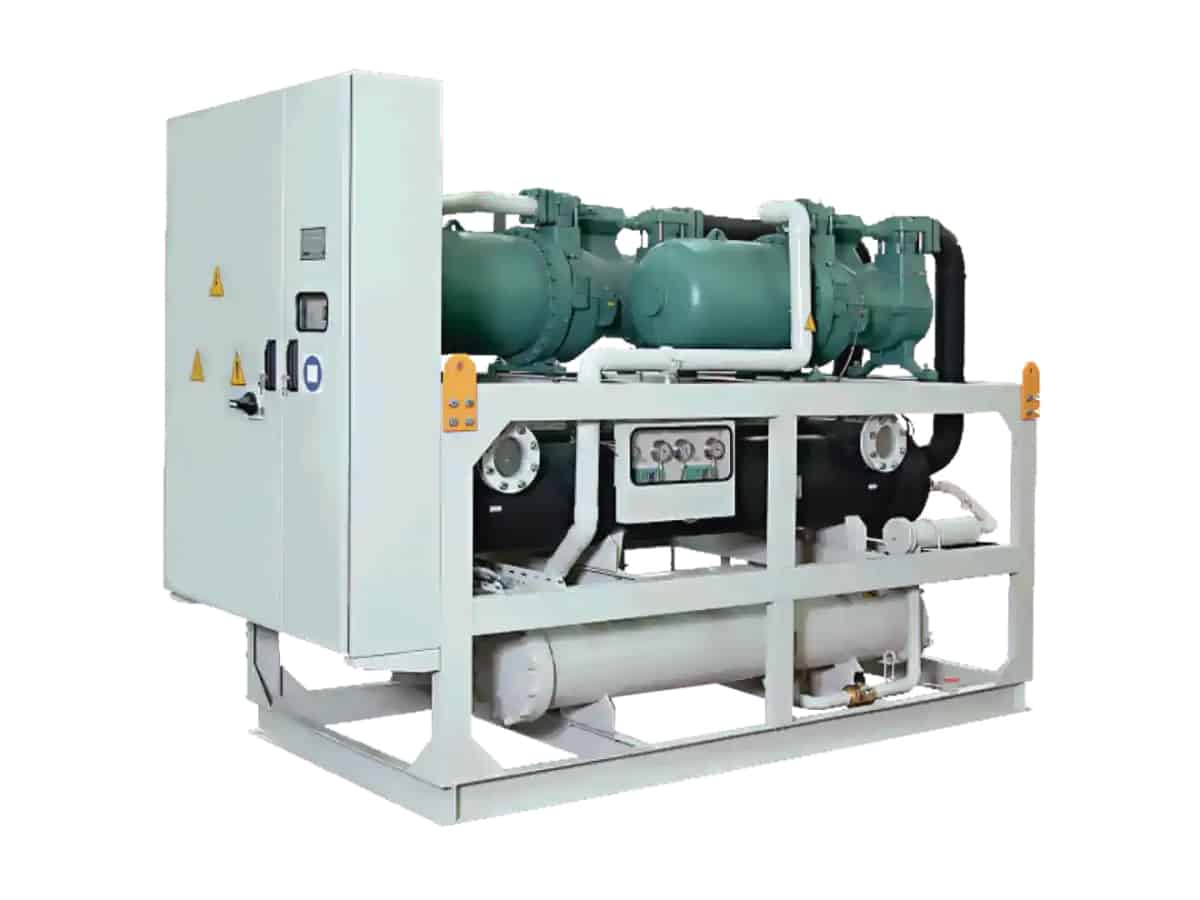
In this article, we will discuss the method of cooling the chiller condenser, namely liquid (water) condenser cooling. What are the advantages of this type of condenser cooling over air cooling? With liquid cooling of the condenser, water or a non-freezing liquid solution is used as a cooling medium, if the conditions require it. For return water supply, both wet and dry cooling towers are used. On ships, seawater is used to cool the condenser. In this case, the condenser must be of a special design and use materials that are not destroyed by sea water.
Chillers with a water-cooled condenser are more compact than those with an air-cooled condenser. They can be placed indoors, for example, in a basement or on a technical floor, in short, it can be installed in a room with limited space. In addition, the cost of a chiller with a water-cooled condenser is lower than a chiller with an air-cooled condenser. This is due to the fact that water has more favorable thermodynamic characteristics than air, which allows for a smaller heat exchanger. And besides, with the same cooling capacity, a chiller with a water-cooled condenser uses a lower-power compressor, and accordingly, the consumption of electricity from the grid is reduced by 30-40%. In the current environment with the high cost of electricity, this is very important for enterprises. Thus, the purchase of equipment such as a cooling tower will pay off in the next year or two.
The condensers used are plate and shell-and-tube, the former being larger and the latter being better, because the shell-and-tube condenser is collapsible and can be disassembled and cleaned if necessary. This feature becomes a decisive factor in the operation of the refrigeration machine.
Dalgakiran chillers are equipped with shell-and-tube condensers and evaporators. Dalgakiran equipment also includes chillers with seawater-cooled condensers in the model range. Such condensers use materials that are resistant to the aggressive effects of sea salt water.
As a universal example of the operation of a chiller with a liquid-cooled condenser and a dry cooling tower, consider this scheme. The condenser is cooled by a dry cooling tower (drycooler). A 35% aqueous solution of ethylene glycol (freezing point – 20o C) is used as a coolant in the circuit. The scheme includes an intermediate heat exchanger, which makes it possible to operate in two modes. The first one is the operation of the chiller and the dryer at an ambient temperature of +28°C , with the dryer cooling the chiller condenser.
The second is the operation of the drycooler and intermediate heat exchanger at an ambient temperature of + 7 ° C. In this case, the chiller does not work, thus saving energy in the off-season and winter. And the consumer receives the set temperature of +18°C all year round.