0800 30 13 77
 0800 30 13 77
 En
En

 Back
BackAir humidity. Dew point.
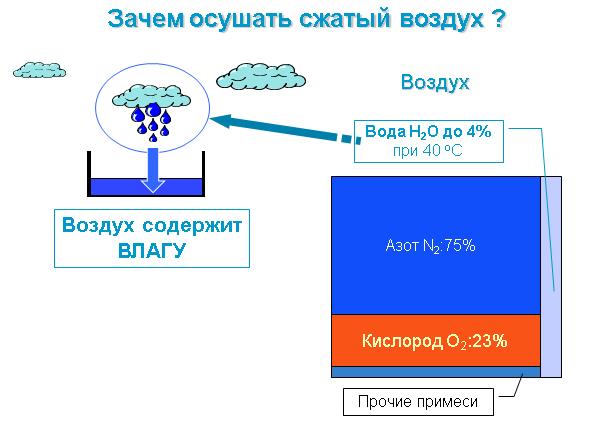
One of the main air parameters that should be considered when designing pneumatic systems is humidity, i.e. the amount of water vapor contained in the air.
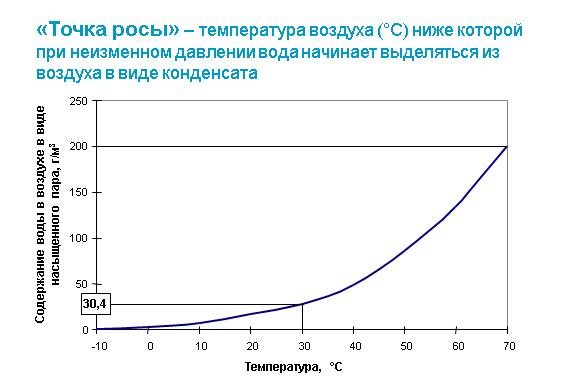
The air entering the compressor from the environment always contains moisture. The value that characterizes how many grams of water a cubic meter of air contains is called “absolute humidity.” It has been established that the ability of air to retain water depends mainly on its temperature. For example, at a temperature of +20°C, one cubic meter of air (under atmospheric pressure) can hold 17.31 grams of water, and at a temperature of -20°C, only 0.88 grams.
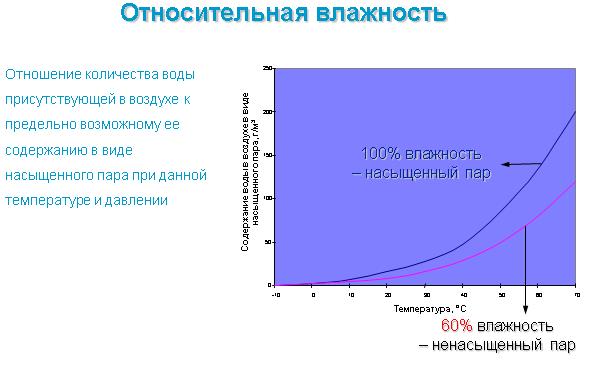
But, as a rule, the source air is partially saturated with water vapor. In order to be guided by how much the air is humidified relative to its maximum moisture retention capacity, the concept of “relative humidity” is used. Relative humidity is measured by special devices called hygrometers. For the proper design of the compressed air production process chain, it is important to know the relative humidity of the source air or its range of fluctuations. For example, at a relative humidity of 60% and a temperature of +20°C, the actual amount of moisture in one cubic meter of air will be 10.38 g/m3.
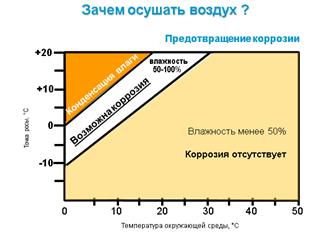
When assessing the amount of moisture that will fall out as condensation in the compressor and pneumatic system during the compression process, as well as deciding to buy a dehumidifier to bring the properties of compressed air to the required parameters, the customer inevitably faces the dew point characteristic, which is one of the main ones when choosing a dehumidifier.
Without going into the intricacies of the physical process, the dew point can be defined as the temperature below which moisture begins to be released from the air (either in the form of fog or condensation). The dew point universally characterizes the dryness of the air and serves as one of the main parameters that determine which dehumidifier to purchase.
The international standard DIN ISO 8573-1 establishes six classes of air purity. Along with the maximum oil and dust content, the standard defines requirements for air humidity:
| Class. | Dew point °C | Field of application |
| 1 | -70 | Pneumatic control systems. Measuring equipment. Pneumatics. High-quality spraying of paints. Final surface treatment. Air for breathing. Brewing production. Production of dairy products. Pharmaceutical industry. |
| 2 | -40 | |
| 3 | -20 | Medical equipment. Air for breathing. High quality air for transportation. Food industry. |
| 4 | +3 | Air for transportation. General plant air. High-quality sandblasting. Pneumatic tools. Pneumatic control systems. Spraying of paints. Air conditioning. Measuring and control systems. |
| 5 | +7 | General industrial air. Air for blowing, sandblasting. Simple painting work. |
| 6 | + 10 |
Today, Dalgakiran offers the widest range of air dryers of various types that can meet the needs of the most demanding consumers.
However, when selecting dehumidifiers and comparing their characteristics, you should pay attention not just to the “dew point” (commonly referred to as “DP”), but to the “pressure dew point” (DPD), the temperature at which moisture condenses in air compressed to operating pressure. The difference is well illustrated by an example: A “pressurized dew point” of +2°C (at a system pressure of 7 bar) is equivalent to a “dew point” of -23°C at atmospheric pressure.
Naturally, the lower the required dew point, the higher the capital and operating costs for air treatment. If you do not take into account all the nuances, it may turn out that the selected dehumidifier will not be able to prepare the required air volumes to the required parameters, or vice versa – the purchased dehumidifier is redundant in its characteristics, and, therefore, the customer has incurred unnecessary costs.
To ensure that the equipment you purchase perfectly matches your production tasks, contact Dalgakiran specialists. We have representative offices in all major cities of Ukraine. Wherever you call: Kyiv, Donetsk, Dnipropetrovs’k, Lviv, Odesa, Rivne, Kharkiv, Khmelnytsky – we will always answer your questions and help you calculate and select the air dryer and other equipment for compressed air production you need.