Energy independence and optimising utility costs have become priorities for both private homeowners and commercial enterprises. In their search for reliable solutions, more and more people are turning their attention to renewable energy sources. However, purchasing high-tech equipment is only half the story. For the system to operate efficiently and safely, and to deliver the kilowatts specified by the manufacturer for decades to come, professional installation of solar panels is essential. Here, we explain the nuances and specifics involved.
What is solar panel installation?
By its very nature, the installation of solar panels is a complex engineering and technical process. It encompasses design, precise mathematical calculations, the assembly of supporting metal structures, the careful handling of photovoltaic modules, and the construction of a complex electrical circuit tailored to the specific characteristics of the site. Every element of the system must be installed in strict compliance with building regulations and electrical safety standards.
Even the most expensive Tier 1 premium-brand panel will not deliver half its efficiency if it is installed incorrectly. Therefore, only a professional solar panel installation guarantees that the equipment will withstand the extreme wind and snow loads typical of our latitudes, whilst ensuring that the building’s roof retains its airtightness and waterproofing properties.
Benefits of installing solar panels
Switching to on-site electricity generation opens up enormous opportunities for the property owner, which go far beyond mere cost savings. Let’s consider the key benefits provided by a high-quality solar panel installation:
Lower electricity bills. The solar power system covers most of the daytime consumption. For a business that operates mainly during the day, this means an immediate reduction in the cost of goods or services.
Protection against power cuts. The panels create an off-grid system that will provide a home or office with light, water and communications during grid failures.
Passive income and net metering. The Net Billing scheme allows you to feed surplus electricity back into the grid, accumulate funds in your account and use them to pay for electricity in winter.
The service life of modern silicon photovoltaic modules is over 25–30 years. As there are no moving mechanical parts, the system requires minimal maintenance once commissioned.
Stages of solar panel installation
The construction of a solar power station must be carried out in a clear sequence of steps, with each stage laying the foundation for the next. Deviating from the technical process at any stage may result in reduced power generation or the failure of expensive electronic components.
Preparing the installation site
Any physical work begins with a thorough site survey by engineers. First and foremost, the strength of the roof or the bearing capacity of the ground (if a ground-mounted structure is planned) is assessed. Specialists calculate the roof pitch and its orientation in relation to the direction of the sun.
A separate critical factor is the analysis of shading. Specialised software is used to simulate the sun’s path throughout the year. This helps to identify hidden threats: shadows cast by chimneys, neighbouring buildings, trees or power lines. If it is impossible to remove the source of the shadow, engineers adjust the module layout or incorporate power optimisers into the design. Following the final calculations, a detailed 3D design of the solar power plant is created and the appropriate type of mounting system is selected.
Installation of mounting systems and panels
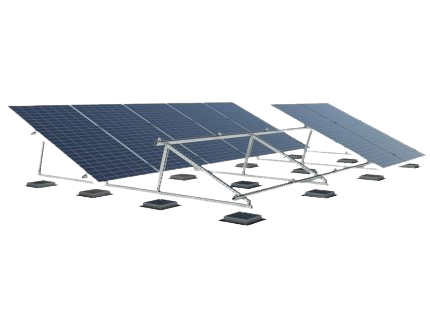
The mounting system is selected depending on the type of roof (metal roofing tiles, bitumen roofing sheets, profiled sheeting or a flat concrete roof). Mounting systems made of anodised aluminium or galvanised steel, which are corrosion-resistant, are usually used.
First, special brackets (screw-in pins or hooks) are fixed to the roof; these are attached directly to the building’s roof truss system rather than to the roofing material itself — this ensures resistance to gale-force winds. Any holes made in the roof are carefully sealed using special EPDM gaskets and UV-resistant sealants. Aluminium guide profiles are mounted on the brackets, forming a perfectly flat surface.
Next, the actual installation of the solar panels begins. Each module is carefully hoisted onto the roof using soft slings or hoists. The panels are secured to the profiles using special inter-panel and end clamps (clamping terminals). At this stage, the panels are sequentially connected into circuits (strings) using sealed factory-fitted MC4 connectors. All direct current (DC) cables are carefully routed through corrugated pipes or metal trays beneath the panels to protect them from direct sunlight, moisture and rodents.
Connection to the electricity grid
Once the solar array has been fully assembled, the direct current (DC) cables are routed down to the inverter installation site. At the same time, the protection system is installed.
The protection system comprises:
DC distribution board — contains special fuses, fuse links and surge protection devices (SPDs), which absorb the impact in the event of a lightning strike on the solar array.
AC panel — fitted with circuit breakers, RCDs (residual current devices) and voltage relays to protect against grid faults.
A mandatory step is the installation of a reliable earthing circuit, to which all aluminium panel frames on the roof, metal structures and equipment enclosures are connected. Once the wiring is complete, the inverter is connected to the building’s main distribution board and the bidirectional meter. Finally, the engineers carry out commissioning work: they measure the open-circuit voltage, test the system under load and set up online monitoring.
The cost of installing solar panels
When planning a switch to alternative energy sources, every property owner wants a clear understanding of the project budget. It is important to realise that the final cost of installing solar panels is never fixed, as it is influenced by a vast number of individual factors.
Firstly, the total capacity of the system and the number of photovoltaic modules are key factors. The larger the system, the more mounting components, cabling and specialist labour time will be required. However, when calculated per 1 kW of capacity, large systems are often more cost-effective than small domestic systems.
Secondly, the complexity and location of the installation have a significant impact on the cost estimate. Work on a steep pitched roof with a pitch of over 45 degrees requires the use of professional mountaineering equipment or specialised machinery (a mobile crane), which increases the final price. Ground-mounted structures incur additional costs for earthworks and concreting the supports. The architecture of the roof is also a factor: if the roof is divided into many small slopes, engineers will have to construct a complex mounting system and use more connecting elements.
To find out the cost of installing solar panels for your property, it is best to arrange for an engineer to visit and take measurements. Attempts to save money by carrying out the installation yourself using online video tutorials often result in panels being blown off by the wind, roof leaks or even fires caused by incorrectly crimped cable connectors. Professional installation by a certified company pays off in peace of mind, an official guarantee for the work carried out, and maximum kilowatt-hour generation at any time of year.
Відгуків немає, поки що.
Будьте першим, хто залишив відгук на “Installation of solar panels” Cancel reply
Delivery across Ukraine:
Courier (by our company)
Pick up yourself, or we will organize delivery throughout Ukraine.
 0800 30 13 77
 0800 30 13 77
 En
En







Відгуків немає, поки що.