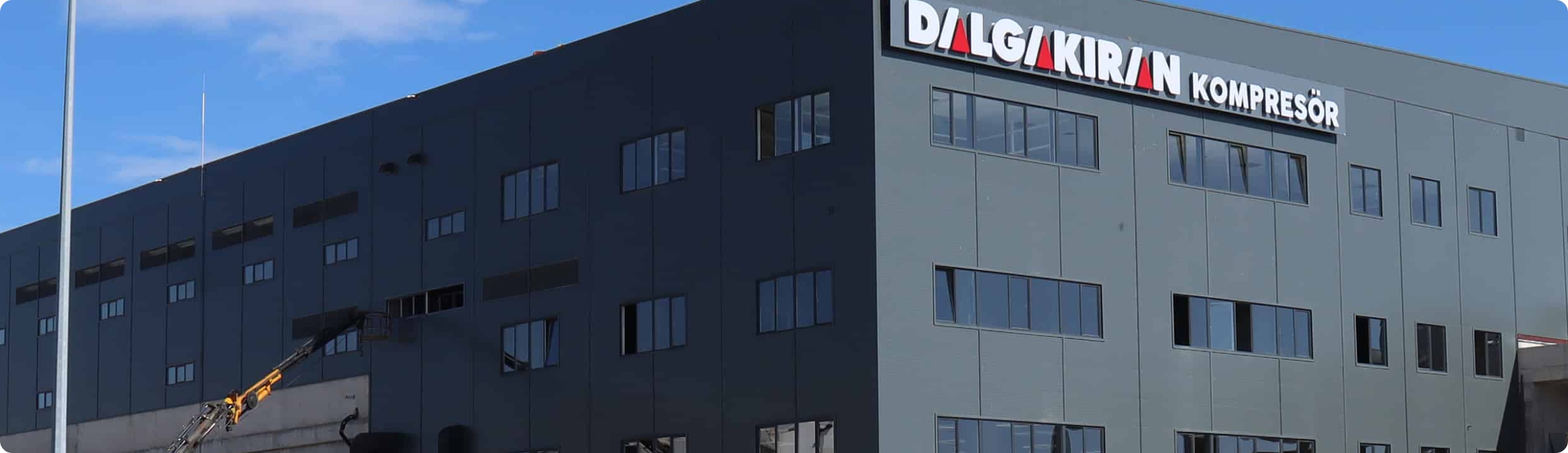
DALGAKIRAN, an industrial company, offers dust extraction and ventilation system design services for all industrial sectors in Ukraine. We develop customised technical solutions and offer energy-efficient equipment for effective removal of dust and industrial pollutants directly at their sources, ensuring proper air exchange and creating a comfortable indoor climate in production facilities. Everything works with DALGAKIRAN!
Sources of dust and air pollution in industrial facilities
In industrial facilities, dust and other air pollutants are primarily generated by technological processes and equipment, including the following:
Crushing and mechanical processing of materials — crushing, cutting, grinding and other operations that generate dust.
Transportation of bulk materials — movement by conveyors, bucket elevators, screw conveyors and pneumatic conveying systems.
Loading, unloading and transfer operations — feeding raw materials and finished products into hoppers, silos and production equipment, as well as transferring materials between process units.
Metering, filling and packaging — measuring components, filling containers and packaging powdered, granular and other bulk products.
Screening and sorting — cleaning, grading and separating materials according to particle size.
Mixing and material processing — preparing mixtures, blending components and feeding raw materials into production equipment.
Thermal processes — heating, drying and welding, which may generate smoke, vapours and other air pollutants.
Dust can also become airborne during routine cleaning of premises. Ventilation and air conditioning systems that are not properly maintained also contribute to its accumulation and recirculation.
Airborne dust creates hazardous working conditions and can negatively affect employees’ health, causing illnesses and allergic reactions. In addition, polluted air reduces equipment efficiency and can lead to malfunctions. Depending on its properties, dust may increase the risk of fire or explosion.
Furthermore, on 8 August 2025, as part of Ukraine’s European integration process, the Law of Ukraine “On Integrated Prevention and Control of Industrial Pollution” came into force, requiring enterprises to implement modern technologies to improve emission control.
Components of a dust extraction system: air intake, ductwork, filtration, discharge and storage
Industrial dust extraction systems remove dust, smoke and unwanted airborne particles. In their basic configuration, dust extraction systems consist of modules responsible for the main functional stages of system operation:
capturing contaminated air using dust extraction hoods and local exhaust units positioned directly at or as close as possible to the source of dust generation, in compliance with all occupational health, fire safety and operating requirements;
transporting the collected contaminated air through main ductwork to the air treatment equipment;
air purification using appropriate dust collection or filtration equipment;
dust discharge and storage systems, which make it possible both to store production waste and to return secondary materials to the production process.
The fan generates the required suction and ensures airflow through the system. Automation components enable dust extraction system control, airflow regulation, equipment condition monitoring and maintenance of the specified operating parameters.
Difference between dust extraction and general ventilation
General ventilation is designed to renew the air throughout an entire room. Therefore, the main purpose of industrial ventilation is to supply fresh, conditioned air and remove contaminated air. A conventional duct network is used to organise airflow.
There are several types of ventilation systems. Supply ventilation systems deliver clean air, while exhaust ventilation systems remove contaminated air from the entire premises. There are also supply and exhaust ventilation systems with heat recovery, which help save energy used for heating or air conditioning. In industrial facilities where there is no intensive generation of dust, chips, steam, smoke or similar pollutants, general ventilation is sufficient. Ventilation can also be used as an alternative heating method or as the only possible way to supply heat to premises, as well as for air conditioning and cooling industrial, administrative and warehouse facilities.
Dust extraction is a technological process for removing dust and gas mixtures. It is required for the local extraction of contaminated air. Its purpose is to prevent pollutants from spreading around their source. The system collects dust, smoke, chips and other contaminants and transports them through ductwork, preventing solid particles from settling inside the system.
Such installations may require fans with appropriate capacity and specialised wear-resistant ductwork. They are primarily needed at industrial facilities with high levels of dust generation.
Difference between dust extraction and ventilation
The approaches to selecting dust extraction and ventilation systems differ significantly. There are two operating principles for dust extraction systems: local and stationary (or centralised). A local system is installed directly at the point where dust is generated, and dust is collected by the filtration unit itself. A stationary or centralised system is installed at any convenient location within the facility and filters dust from the air supplied to the filtration unit through a ductwork network. Several dust-generating points can be connected to a centralised system.
A basic layout of a stationary dust extraction system may look as follows:
Source of contamination.
Local extraction hood.
Ductwork.
Dust collector/filter.
Dust discharge and storage.
Fan.
Discharge of cleaned air.
The layout of a local dust extraction system is different and has a significantly simpler configuration:
Sources of contamination.
Central dust collector/filter.
Fan.
Discharge of cleaned air.
To select the right ventilation system, it is necessary to conduct a detailed analysis of requirements, the intended use of the premises, and the climatic conditions of the building and surrounding area. Only with all the necessary data available is it possible to determine whether an exhaust, supply or supply and exhaust ventilation system is required. An exhaust ventilation system consists of the following key components:
Air intake from the premises through exhaust grilles or diffusers.
Air transportation through the ductwork network.
Discharge outdoors using a fan or ventilation unit.
A supply ventilation system operates according to the following layout:
Outdoor air intake.
Filtration.
Supply unit/fan.
Air treatment: heating, cooling, dehumidification or humidification.
Air transportation through the ductwork network.
Supply of clean air into the premises through supply diffusers or grilles.
A supply and exhaust ventilation system uses two circuits: supply and exhaust. The layout is as follows:
Exhaust system
Supply system
Air is drawn from the room through exhaust grilles or diffusers.
Fresh air enters the room through supply diffusers or grilles.
Transport via a duct network
Transport via a duct network
Filtration
Supply unit / fan
Air treatment: heating, cooling, dehumidification, or humidification
Heat recovery unit
Fan
Filtration
Exhaust to the outside via a fan or ventilation unit
Outdoor air intake
In practice, these layouts are often combined. Local dust extraction is used to remove contaminants at their source, while a centralised ventilation system maintains a balance between fresh and exhaust air throughout the premises.
Selection of dust extraction and ventilation systems with Dalgakiran
At DALGAKIRAN, we select optimal solutions for every type of industrial facility. We take into account the required airflow rate, system resistance, the nature of the contaminants and the required conveying velocity. We recommend particularly strong and wear-resistant ductwork for abrasive dust.
Our in-house engineering department designs and, when necessary, improves our products. We not only supply equipment but also provide maintenance services for dust extraction and ventilation systems to ensure their reliable operation.
We visit facilities to assess requirements and subsequently carry out installation work in 11 regions of Ukraine. Based on the equipment process layout in the production area, we prepare an airflow calculation table and determine the number, capacity and location of dust extraction and ventilation systems, taking safety requirements into account. We improve working conditions in individual production areas and contribute to the development of Ukrainian industry as a whole.
Frequently asked questions about dust extraction and ventilation
How does aspiration differ from ventilation?
Aspiration collects airborne contaminants directly from the industrial process, while ventilation renews the air and ensures a healthy indoor environment throughout the facility.
What data is needed to select an aspiration system?
To select an aspiration system, you need to know the type and number of pollution sources, the number of collection points for contaminated air, the air flow rate, the operating mode, the temperature of the dust-gas mixture, the humidity and temperature inside the facility, as well as its floor plan and ceiling height. Important information: the type, concentration, and intensity of contamination, as well as the dispersion and, if necessary, the humidity, abrasiveness, and flammability of the contaminants. We understand that not all parameters can be provided, as they require modern analysis and expertise; however, you can always request a Dalgakiran specialist to visit the site or receive a free consultation.
When is local dust collection necessary?
Local dust collection is necessary when harmful dust is generated in high concentrations at a specific, fixed location. Safety regulations and technical requirements may mandate local dust collection. In some cases, it is more cost-effective to clean a single zone rather than a large area.
How do you choose between cartridge and bag filters?
If you need to collect fine, dry dust at low concentrations, cartridge filters are a good choice. Bag filters are required for collecting large volumes under high-temperature conditions.
Can an extraction system be integrated into an existing production facility?
Yes. Based on a custom design, an extraction system can be integrated into a production facility that is already in operation.
Need a consultation?
Fill out the form and we will call you.
Your region
Request a call
Thank you, your request has been sent. A manager will contact you shortly.
 0800 30 13 77

 0800 30 13 77
 En