0800 30 13 77
 0800 30 13 77
 En
En

 Back
BackChiller for an ice rink – technical features of the equipment

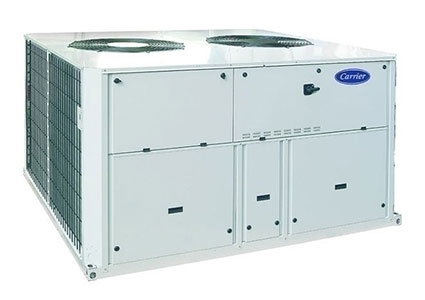 One of the applications of low-temperature chillers is the creation of outdoor or indoor ice rinks. The main requirement for a chiller for ice rinks is the ability to maintain the temperature of the cooling medium in the range from -9 to -12 °C. Depending on the area of the ice surface and its operating conditions, the system for creating ice can vary greatly. For example, a full-fledged hockey ice arena may require an installation with a capacity of up to 300 kW. Small seasonal skating rinks and ice rinks in shopping malls can be equipped with much less powerful equipment that can be easily transported if necessary.
At Dalgakiran Compressor Ukraine, you can order a cooling system in which our specialists will take into account all the features of the facility and the specifics of its use.
What is a low-temperature chiller?
A chiller with a boiling point of freon in the evaporator of zero degrees Celsius and below is considered low-temperature. Water is not suitable for this type of equipment, but antifreeze is used. Depending on the technical conditions and the required refrigerant temperature, non-freezing solutions of various composition and concentration are used. Special low-temperature freons are used in such chillers.
Technical features of low-temperature chillers
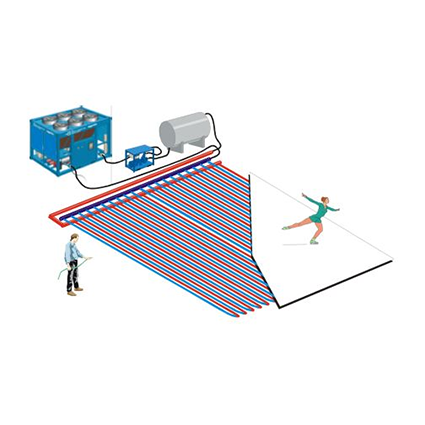 Such refrigeration equipment is based on special low-temperature compressors capable of handling refrigerants with a boiling point of -45 °C.
Only shell-and-tube evaporators are used, as well as special pumps for working with low-temperature liquids.
All refrigeration circuits are insulated with improved thermal insulation characteristics.
In general, all of this increases the cost of construction and increases electricity consumption compared to “conventional” medium-temperature chillers.
How does the ice field work?
At the base of the field is a flat concrete slab that serves as the foundation. A layer of thermal insulation is placed on top of it so that the slab does not freeze on its own and at the same time does not cause the ice cover to melt. On top of the thermal insulation is a layer of waterproofing that prevents water leakage. The field itself is filled in several stages – in layers. This is necessary to speed up the process of creating the ice surface and ensure its strength. A thin layer freezes faster and more evenly, and a reinforcing mesh is laid as intermediate reinforcing layers.
Chillers for ice arenas
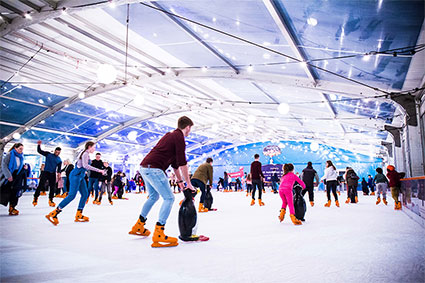 Such equipment should be able to operate in a wide temperature range with adjustable cooling capacity, high efficiency and cooling coefficient.
Since chillers of this capacity have starting currents that are two to three times higher than the operating currents, they are equipped with a soft start system for the compressor.
A system of temperature sensors in combination with automation allows you to maintain the ice surface in optimal condition, regardless of the season. In addition, remote monitoring and control support can be implemented.
Chiller for a mobile ice rink
In the winter season, outdoor ice rinks are not uncommon. Their small area and more modest requirements for the quality of the ice surface make it possible to use low-temperature chillers of low power to create them. Such equipment is quite easy to transport and does not require a large space for placement.
Not only concrete slabs are used as a base, but sometimes asphalt or wooden flooring is also used. The main requirement is a flat surface. In any case, additional layers of thermal insulation and moisture barrier are required, as well as condensation drainage. For a mobile ice rink, a flexible cooling system is used on the underlayment – the so-called “ice mat”. It is easy to transport, and the risk of damage is quite low.
In terms of temperature, the maximum temperature at which it is still advisable to maintain an ice coating should not exceed +10 °C.
The ability to quickly deploy equipment and its high wear resistance make this specific seasonal ice rink construction business quite attractive.