Managing power systems effectively means directly reducing an industrial facility’s operating costs. However, energy efficiency audits often reveal a common mistake: managers focus exclusively on active kilowatts, while the reactive component is overlooked. Local grid parameter balancing helps prevent losses. Below, we’ll examine the engineering logic behind this process, compare different types of equipment, and determine how to calculate the system’s capacity for a quick return on investment.
What are reactive power compensation devices and their features?
The current in three-phase industrial networks is heterogeneous—it combines active and reactive components. The active component is straightforward: it provides heat, rotates machine shafts, and powers production lines. Reactive energy does not perform any mechanical work at all. However, it is indispensable, as it is needed to create magnetic fields, without which induction motors, power transformers, or welding systems cannot operate.
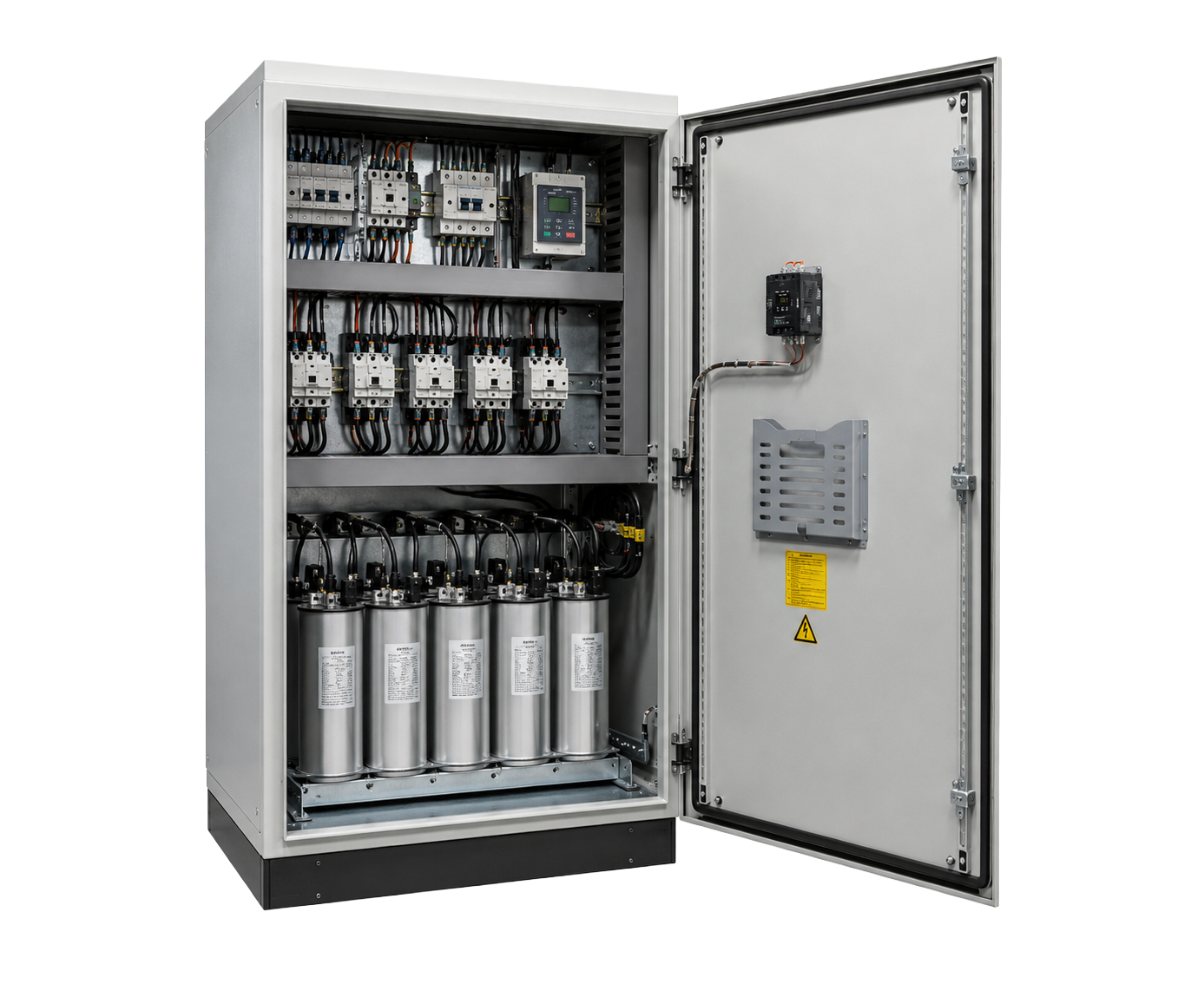
When this current flows continuously from distant substations to production facilities, it overloads the grid infrastructure. To relieve the load on the wires, a reactive power compensation device (RPCD) is installed directly near the load. The purpose of the installation is to generate this energy locally. The efficiency level is determined by the power factor cosφ—the ratio of active power to total power. While this figure reaches up to 0.7 at non-modernized facilities, after connecting RPC modules, it consistently stabilizes at 0.95–0.98.
How reactive power compensation devices work
The technology is based on balancing inductive and capacitive reactance. Since production areas are typically equipped with electric motors, the total load is predominantly inductive. As a result, the current lags behind the voltage in phase. Parallel integration of the compensator with cosine capacitors solves this problem by creating a leading current and compensating for the phase shift.
As a result, all power exchange is confined within the local “capacitor–motor” circuit. Reactive current practically does not leave this system, which relieves the facility’s central transformer of excess load. The facility’s central transformer is unloaded, voltage sags disappear, and the cables stop overheating.
To protect the capacitors from dangerous higher harmonics, the circuit is supplemented with protective anti-resonance chokes. Such engineering protection is mandatory for lines where powerful industrial frequency converters are used extensively, as they significantly distort the ideal sinusoidal current waveform.
Types of reactive power compensation devices
Designers select the specific equipment configuration based on the individual operating schedules of the workshops and the characteristics of the technical processes. Modern industry uses three main classes of devices.
Static capacitor banks
This is the classic, proven, and most affordable modernization option. Structurally, the equipment consists of step-type cosine capacitors controlled by mechanical contactors or semiconductor thyristor switches. Models with thyristors provide instantaneous response, which is important for facilities with intermittent loads, such as workshops with spot welding operations.
Synchronous compensators
This role is performed by specialized synchronous motors that operate without a mechanical load on the shaft. By regulating the excitation current, such a unit can flexibly supply reactive power to the grid or absorb its excess. In industrial settings, such tasks are often handled by local high-voltage frequency converters, which, thanks to active rectifiers, are capable of maintaining a stable power factor for heavy-duty drive systems.
Active power filters
These are high-tech, next-generation electronic devices based on IGBT modules. They not only compensate for reactive current but also inject higher-order harmonic currents into the grid in antiphase, neutralizing any nonlinear distortions and phase imbalances. Such equipment is critically important when sensitive low-voltage frequency converters are operating in parallel, as they distort the ideal power supply sine wave during regulation.
Benefits of using reactive power compensation devices
The integration of compensation systems provides a comprehensive technical and economic benefit that directly contributes to reducing production costs.
Key benefits of implementing reactive power compensation systems:
minimization of additional charges on bills for reactive energy;
a 3–5% reduction in total active power consumption by reducing heat losses in cables;
reducing the load on power transformers, which allows new equipment to be connected without increasing power limits;
improving voltage levels and stability in remote sections of the grid;
Extending the service life of switching equipment and circuit breakers by reducing overloads.
Thanks to these factors, capital investments in the modernization of the power distribution system pay for themselves in record time, turning expenses into permanent net savings.
How to choose a reactive power compensation device
Before purchasing a reactive power compensation device, it is necessary to conduct a comprehensive pre-project survey of the facility. The main parameter is the system’s total reactive power (in kvar), required to achieve the target cosφ value. The calculation is based on an analysis of utility bills or on direct measurements of network parameters using power quality analyzers.
The following factors should also be taken into account:
Control type: fixed (for individual motors) or automatic step-by-step (for the entire facility).
Control step size: the lower the power of a single step, the more accurately the automation will maintain balance without the risk of overcompensation.
Environmental conditions: dust levels, humidity, and temperature at the PFC installation site.
Dalgakiran’s specialists design compensation systems both as standalone solutions and as part of a comprehensive drive modernization project. During such upgrades, special ready-made container solutions are used to protect high-power frequency converters in outdoor locations.
Benefits of ordering PKRM from Dalgakiran
We supply highly reliable systems assembled from premium European components, ensuring high safety and a long service life for the capacitor banks. Thanks to direct distribution contracts, the final price of the reactive power compensation device remains transparent, competitive, and fully justified.
By choosing our team as your partner, you receive a full cycle of “turnkey” engineering services. Our specialists will independently conduct a network measurement audit, develop a customized project, provide a complete package of technical and permitting documentation in accordance with current legislation, and perform professional installation and commissioning of the systems. Going forward, clients can count on continuous service support and a rapid response from our mobile engineering teams.
The implementation of highly efficient, energy-saving equipment helps domestic factories and plants operate at full capacity to support Ukraine’s economic development, because even during peak loads, everything runs smoothly with Dalgakiran.
 0800 30 13 77
 0800 30 13 77
 En
En







Відгуків немає, поки що.