DALGAKIRAN heat exchange equipment for industrial applications
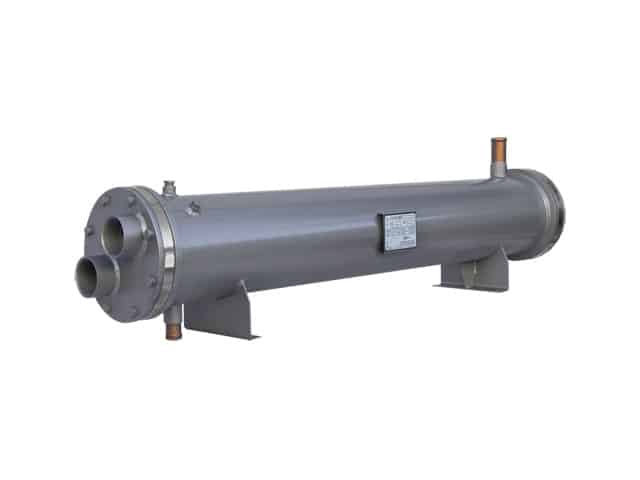
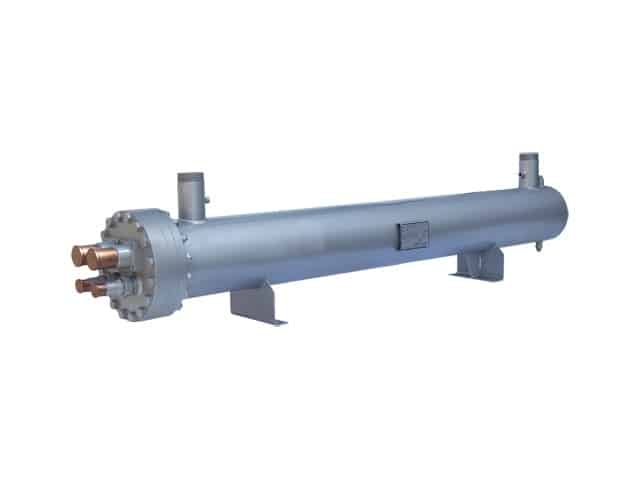
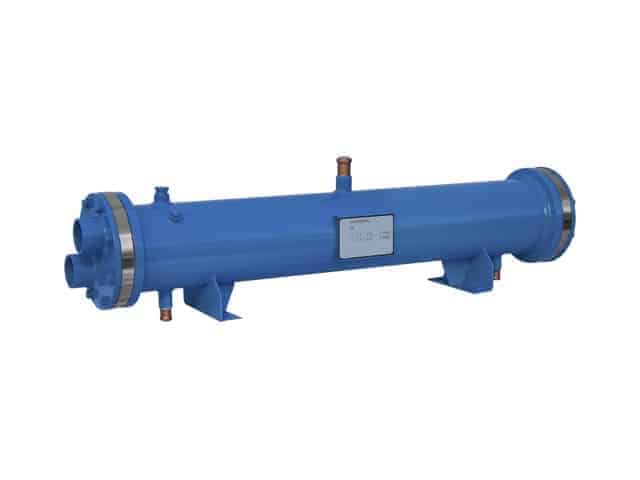
DALGAKIRAN shell-and-tube evaporators are used for cooling water or aqueous glycol solutions. Evaporators of the ECH series include a wide range of models with 1 or 2 cooling circuits with a capacity from 7.9 to 832 kW. The design with a specially feathered copper tube allows for a larger heat exchange area and higher heat transfer, while reducing the size of the heat exchanger itself. Suitable refrigerants are all hydrochlorofluorocarbon (HCFC) and all hydrofluorocarbon (HFC). The special design of the interchangeable tube bundle makes it easy to clean the evaporators.
DALGAKIRAN ESK(D) series condensers are designed for condensing working media in an enclosure. They are available in models with capacities ranging from 10.3 to 692 kW. As with the evaporators, all hydrochlorofluorocarbon (HCFC) and all hydrofluorocarbon (HFC) refrigerants are suitable. DALGAKIRAN ESKD condensers use copper-nickel alloy tubes for seawater cooling.
The following features are common to all types of heat exchangers:
high build quality and reliability of the units;
simple design and low maintenance costs;
resistance to scale;
high energy efficiency;
long period of continuous operation until the moment of scheduled maintenance.
DALGAKIRAN evaporators and condensers are manufactured using high quality materials that meet all the requirements of the European Pressure Equipment Directives. They have been tested under a pressure of 10 bar for water and 30 bar for refrigerant. Our shell-and-tube evaporators can be welded or flanged to the water inlet and outlet pipes.
The DALGAKIRAN shell-and-tube cooling heat exchanger utilizes an original internal tube design. The corrugated surface of the pipe interacting with water causes turbulence in the flow. As a result, the coolant is actively mixed and heat transfer increases. This design made it possible to create freon/water heat exchangers with high cooling efficiency and small dimensions. In addition, the increased turbulence of the fluid flow and high-quality polishing of the heat exchange surfaces allow the Freon/water heat exchanger to be kept clean. This is reflected in the extended service life of DALGAKIRAN shell-and-tube evaporators and condensers.
Shell-and-tube heat exchangers are an extremely important element in cooling systems that require efficient heat transfer from one medium to another. This equipment is widely used in the industrial sector, and is also in demand in heating, air conditioning and energy systems. A well-made shell-and-tube heat exchanger combines many advantages: compactness, high heat transfer characteristics, and wear resistance. It is hard to imagine most technological projects without these devices.
In this article, we’ll look at how a shell-and-tube heat exchanger works, what types of this device are available, as well as how much such equipment costs and where it is profitable to order it with delivery in Ukraine or in Kyiv.
The principle of operation of shell-and-tube heat exchangers
The principle of heat exchangers is to efficiently transfer heat between different media through the walls that separate them. These devices consist of basic components such as an outer shell and inner tubes through which the heat transfer medium flows.
How does it work in simple terms? One medium, which can be a liquid, freon or gas, is transported through pipes, while the second medium (hot water, steam or any other heat transfer medium), with which heat is exchanged, circulates in a jacket around the pipes. Heat exchange occurs by heating the walls of these pipes.
The following factors affect heat transfer efficiency:
design features of the heat exchanger (diameter, length and number of tubes, wall thickness, material quality, etc.);
thermal and physical properties of heat transfer fluids;
hydraulic conditions, etc.
The cost of a device depends on how functional and efficient it is. We advise you to buy only certified and time-tested products from reliable manufacturers, for example, contact Dalgakiran Ukraine LLC and choose the right equipment for yourself.
Types of industrial heat exchangers
Industrial heat exchangers can be of several types. Here are the most common ones:
Shell and tube heat exchanger. It consists of a shell on the outside and tubes on the inside. The construction is usually metal, made of steel or titanium. The pipes are located in the shell and can be of different sizes. The heat carrier, such as freon or other liquid, flows through the pipes, while another heat carrier, such as water, steam, etc. circulates around them. Heat is transferred through the pipe walls between the two media. This type of heat exchanger is widely used in the chemical industry, oil and gas, power generation, and other industries where efficient cooling or heating of liquids, high-pressure gases, or high-temperature conditions is required.
Plate heat exchanger. Most often consists of metal plates arranged one behind the other. Fluids pass between the plates without mixing. One heat transfer medium flows through the paired channels, the other through the unpaired channels. In this way, heat is transferred through the metal plates from one heat transfer medium to another. Typical applications for such heat exchangers include the food industry, pharmaceutical companies, and manufacturing facilities that require high-quality air conditioning and cooling.
Tubular heat exchanger. The design involves one or more metal tubes, which can be straight or zigzag. The arrangement of such pipes is parallel, one after the other. The principle of operation is that one medium circulates in the pipes and the other around them. Heat is transferred through the pipe wall from one medium to the other. This type of heat exchanger is most commonly used in heating and air conditioning systems, and also plays an important role in water supply and sewage processes.
It should be noted that each type of these devices has its advantages and disadvantages. But the most reliable and popular option is the shell-and-tube type of heat exchanger. Let’s take a look at its main advantages compared to other types of industrial equipment.
Advantages of shell-and-tube heat exchangers
Shell-and-tube heat exchangers have a number of significant advantages. They are as follows:
Efficient heat exchange. It is ensured by the volume of the contact surface between the coolants. This makes it possible to quickly transfer heat from one medium to another without loss of efficiency, regardless of whether the heat carrier is liquid, gas or steam.
Durability and reliability. The robust construction of shell-and-tube heat exchangers, usually made of durable steel or titanium, significantly extends the service life of the heat exchanger and ensures its reliability in use. The simple and robust design also makes it possible to use the equipment under high pressure and extreme temperatures, which is a prerequisite for some industries, such as oil and gas, chemicals, etc.
Easy modification and repair. Maintenance of shell-and-tube heat exchangers is easy, as the design of the device is quite simple. Replacing the tubes does not take much time and effort, as well as modifying other parts of the device.
Versatility. Shell and tube heat exchangers can be used in a large number of technological and industrial processes in a wide variety of industries.
Shell-and-tube heat exchangers are reliable and efficient equipment that can be used in a wide variety of industrial processes.
Characteristics of shell-and-tube heat exchangers
Shell-and-tube heat exchangers have different operating parameters. Let’s take a closer look at the design features of this device, as well as its dimensions and other characteristics:
Type of construction and materials. As we have already mentioned, shell-and-tube heat exchangers consist of tubes and a casing. In turn, the pipes can be of different shapes – straight or zigzag. This depends on the hydraulic characteristics and heat transfer requirements. The device itself can be made of various metals, and the best ones are carbon steel, titanium, brass, nickel, stainless steel, etc. In some conditions, structural strength and corrosion resistance are extremely important criteria.
Types of heat exchange. There are two types of heat transfer: direct and reverse. It depends on the orientation of the coolant flows. For example, direct heat transfer is a direct interaction between heat transfer fluids through the pipe walls, while reverse heat transfer occurs by reversing the direction of flow.
Dimensions and geometric parameters. Heat exchangers can be either small in size, suitable for simple, undemanding tasks, or large, for complex industrial processes. The more pipes, the larger the diameter and length, the more powerful the device will be.
Thermal performance. Depending on the materials and design of the shell-and-tube heat exchanger, different temperature and pressure limits can be applied. The efficiency of the heat exchange itself is determined by parameters such as the size of the heat exchange surface and hydraulic losses.
The applications for shell-and-tube heat exchangers are unlimited – they can be used anywhere that requires efficient and controlled heating or cooling of air.
When purchasing a shell-and-tube heat exchanger, you should take into account each of these parameters, as they will determine its efficiency and reliability in the conditions where you plan to use it.
What to look for when buying
If you are planning to purchase a shell-and-tube heat exchanger, be sure to pay attention to the type of construction, materials of manufacture, capacity, dimensions, and cost.
Consider the design features. The heat exchanger may have a different number of tubes. Carefully choose the model that suits your operating conditions. There is a significant difference between single-tube heat exchangers and, for example, three-tube heat exchangers, because they have different purposes. Single-pipe devices are used for simple tasks, while three-pipe models are used in more complex industrial processes where cooling or heating is part of the production activity.
Choose only reliable materials. If the heat exchanger is made of a high-quality metal, such as titanium, it will be more reliable and durable, and you will be able to use the device in harsher environments. This includes compatibility with various chemicals, high and low temperatures.
It is equally important to choose the optimal size. If you have limited space, it is better to choose a small model of the device. Keep in mind that both small and large models require regular maintenance and cleaning. For industrial devices, this process can be more complicated.
It is also worth clarifying the technical parameters of the device from the manufacturer – heat output, maximum allowable pressure, temperature of the working medium, flow volume, and heating/cooling rate. This information will allow you to buy equipment that will be relevant and useful for your business. Depending on the characteristics, the price may vary.
The quality and reliability of the manufacturer is one of the key parameters when choosing heat exchange equipment. The brand must have a solid reputation among users, provide a warranty for its products, and offer professional service for its products. “Dalgakiran Ukraine LLC meets all these requirements and offers a number of additional benefits:
We work not only in Kyiv but also throughout Ukraine – delivery and repair of equipment is carried out 24/7, in the most convenient way for the client.
Our products are certified and meet all the necessary quality and safety standards.
Dalgakiran equipment can be rented, not just purchased.
Optimal price for products and their availability for everyone.
We are always open to cooperation, as we know how important it is to support Ukrainian business in this difficult time for the country.
You can always order a high-quality heat exchanger by contacting our specialists at the phone number listed on the website. We will advise you for free, tell you how much our equipment costs, whether it is suitable for your business, how to maintain it, etc.
Dalgakiran – everything works with us! Trust only professionals. Call us to get more detailed information.
Need a consultation?
Fill out the form and we will call you.
Your region
Request a call
Thank you, your request has been sent. A manager will contact you shortly.
 0800 30 13 77
 0800 30 13 77
 En
En