0800 30 13 77
 0800 30 13 77
 En
En

 Back
BackSolar energy for business: when is it worth investing in your own solar power station?
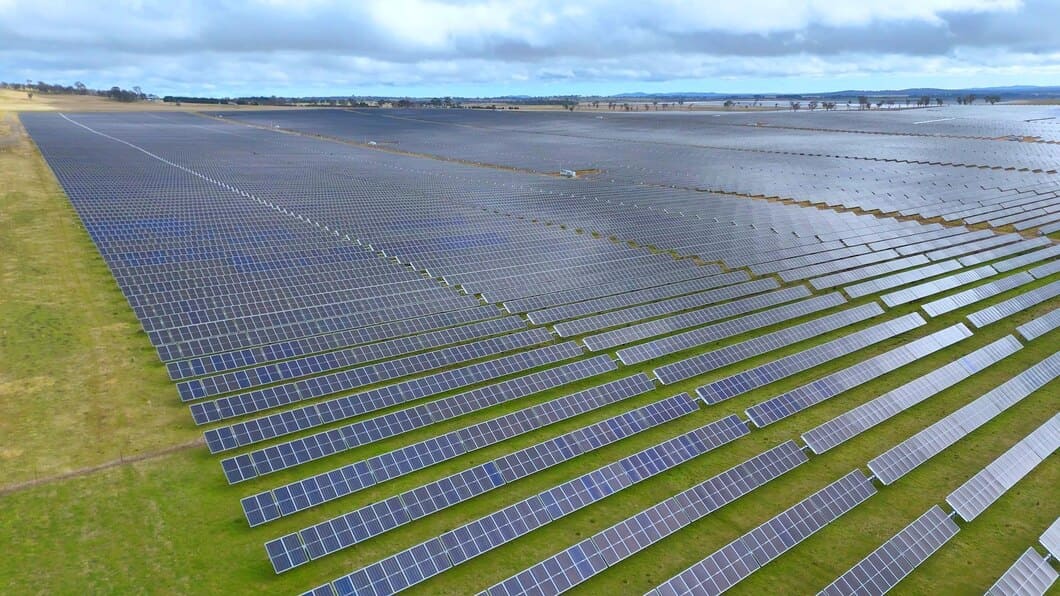
Rising electricity tariffs in Ukraine are forcing businesses to seek alternatives. A solar power station for businesses is an excellent way to reduce costs and improve operational stability. In this article, we will look at the benefits of owning a solar power station for businesses, the technical and legal issues that need to be resolved before commissioning, and the risks to consider before signing a contract with a contractor.
The benefits of investing in solar power stations for businesses
Solar power stations for businesses mean, first and foremost, savings: lower monthly electricity bills and protection against unpredictable tariff rises. But the financial aspect is only part of the picture.
A company that generates its own electricity achieves energy independence in the broadest sense: the production process is not halted by power cuts, equipment does not fail due to voltage surges, and electricity costs become more predictable.
Key financial benefits include:
- Savings on electricity bills — depending on the solar power plant’s capacity and consumption profile, a business can cover between 30 and 100 per cent of its own daytime needs.
- Reduced operating costs and, as a result, lower production or service costs.
- The ability to sell surplus electricity back to the grid — via net-billing or other applicable schemes.
- Increased value of the company’s property: a building with its own power generation is worth more on the market.
The payback period for businesses with significant daytime consumption is usually between 3 and 6 years, after which the solar power plant effectively generates ‘free’ electricity for a further 20–25 years.
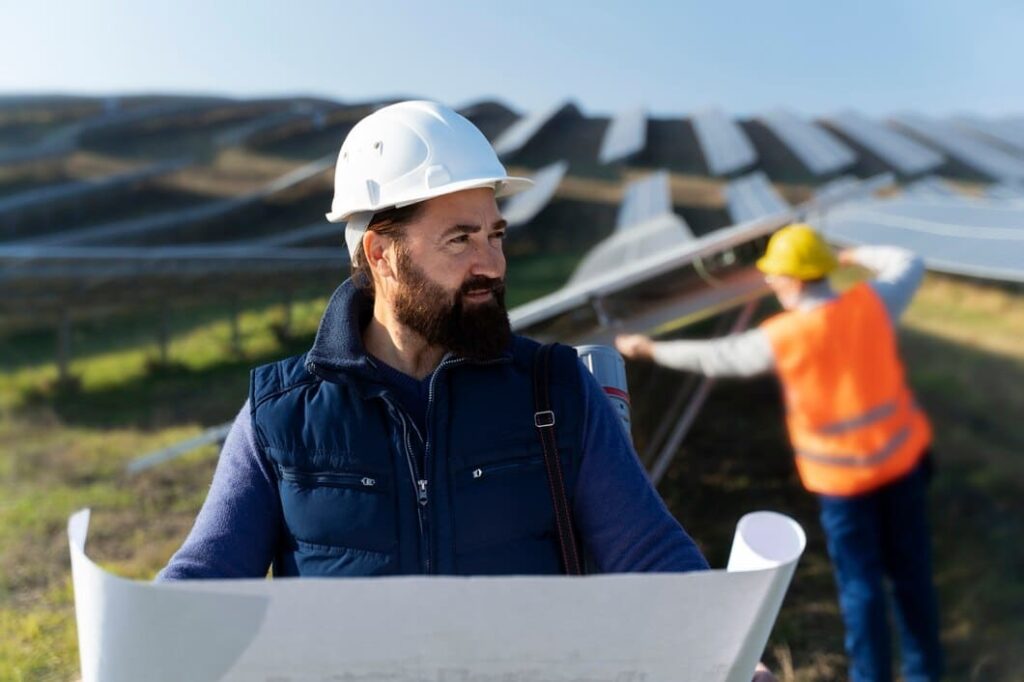
Technical aspects of installing a solar power plant at a business
The project cost, payback period and operational reliability of the plant depend on the correctness of the technical decisions made at the outset.
Choosing the capacity and type of equipment
The first question a business manager faces is: what capacity is required? There is no one-size-fits-all answer: it all depends on the volume of consumption, the area of a suitable roof or plot of land, and the budget.
For small and medium-sized businesses, the typical range is between 20 and 100 kW. Large manufacturing facilities and logistics complexes can install systems with a capacity of 500 kW or more. Before making a decision, it is worth commissioning a solar power plant design — this will provide an accurate picture of the capacity, payback period and specific characteristics of the site.
By connection type, solar power stations for businesses are divided into:
- Grid-connected — connected to the public electricity grid, with surplus energy fed back into the grid.
- Hybrid — combine solar power, the grid and batteries, which is particularly relevant where the electricity supply is unstable.
- Off-grid — completely independent of the grid, requiring a large battery bank.
For most businesses in Ukraine, a hybrid system is the optimal choice: it provides both energy independence and flexibility in consumption. Incidentally, the correct selection of inverters directly affects the stability and efficiency of the entire system.
Requirements for the installation site and infrastructure
The technical aspects of installation depend directly on the condition of the site. The roof must be able to withstand the additional load from the panels and mounting structures. A technical inspection of the roof must be carried out before work begins.
The main requirements for the installation site are set out below.
|
Parameter |
Recommended figure |
|
Roof orientation |
South or south-east/west |
|
Angle of inclination of the panels |
25–35° for most regions of Ukraine |
|
No shading |
At least between 9.00 and 17.00 |
|
Load-bearing capacity of the roof |
From 15–20 kg/m² of additional load |
|
Distance to the switchboard room |
Preferably up to 50 m to minimise losses |
If the roof is unsuitable — for example, due to the roofing material or the pitch — a ground-mounted installation on a designated plot is considered. Both options have their advantages, and the right decision depends on the specific site.
Legal and regulatory issues in the implementation of solar power plants
Before proceeding directly to the installation work, it is worth familiarising yourself with the regulations.
Permits and licensing
Regulations governing the solar energy sector in Ukraine have been significantly simplified in recent years, although a certain set of documents is still required. The procedure is more complex for legal entities than for households.
Generally, to connect a solar power plant, a business must obtain technical specifications from the regional electricity distribution company, have the project approved by the relevant authorities, sign a grid connection agreement and complete the connection process. The final step isconnecting the solar panels, which must be carried out by licensed specialists, as this involves connecting to the industrial electricity grid.
For solar power plants with a capacity exceeding 1 MW, a licence to generate electricity from the NEURC is also required. This is not required for smaller installations.
Tax incentives and government support schemes
Financing solar power plants through government schemes is another argument in favour of investment. Several support mechanisms are in place in Ukraine:
- VAT exemption on the import of equipment for the generation of electricity from renewable sources (in accordance with the Tax Code of Ukraine).
- The option to include the costs of constructing a solar power plant as part of depreciable assets, thereby reducing the tax base.
- Loan programmes offered by a number of banks with preferential interest rates for renewable energy projects.
- The net-billing mechanism, which allows surplus electricity generated to be monetised.
‘A business that invests in solar power generation today is effectively locking in its electricity costs for the next 25 years — and this is at a time when tariffs for industrial consumers are rising every year.’
Risks and challenges when investing in solar power stations
Any investment carries certain risks, and solar power plants are no exception. Understanding these risks helps you make an informed decision.
Firstly, there are technical risks: if solar panels are installed without a high-quality design or with a cheap inverter, actual generation may differ significantly from the calculated output. That is precisely why the installation of solar panels must be carried out by an experienced team offering a guarantee on the work.
Secondly, there are regulatory risks: legislation governing renewable energy in Ukraine is subject to change, and the terms for selling electricity to the grid may be adjusted. Therefore, when calculating the payback period, it is better to base your calculations on a scenario of self-consumption rather than on income from sales.
Thirdly, financial risks: the high initial cost of the system requires either the availability of spare funds or the taking out of a loan. In the latter case, it is important to calculate the cash flow correctly.
There is also the weather factor: solar panels generate less power in overcast weather and during winter. For most regions of Ukraine, this is not a critical issue — over the course of a year, the system generally meets its projected output, but seasonal fluctuations must be factored into the financial model.
Conclusions
A solar power plant for businesses is a solution that offers real savings, transparent costs and protection against power supply instability. For most businesses with significant daytime electricity consumption, the investment will pay for itself within 6 years, after which the solar power plant will continue to benefit the business for another two decades.
Start by analysing your own consumption and commission a project — this will give you a clear understanding of the capacity, cost and payback period specific to your business. A considered approach from the outset is the key to ensuring that the solar power plant becomes an asset rather than a headache.