0800 30 13 77
 0800 30 13 77
 En
En

 Back
BackWater aeration

Aeration is one of the most cost-effective ways to treat large volumes of water today. Aeration is based on the method of purifying water by saturating it with oxygen, which in turn leads to chemical and biological reactions. Today, aeration systems are used to treat wastewater at wastewater treatment plants, for reservoirs, ponds and lakes.
Aeration is a general term for a method of water treatment, which in practice has three different implementation technologies. Let’s take a closer look at all water aeration systems. First of all, we will look at how a compressor is used for water purification and give an example of how equipment from Dalgakiran Compressor Ukraine helps to create modern and energy-efficient water purification systems.
Mechanical aeration
Mechanical aeration of water offers the simplest and yet safest solution to the problem – intensive air supply directly into the water. Due to this, there is:
- Purification of water from iron and removal of manganese, which are oxidized and settle to the bottom in the form of flakes.
- Binding and removal of hydrogen sulfide and methane from water.
- Disinfection – oxidation destroys harmful bacteria.
- Biological treatment – the growth of aerobic bacteria from the increased oxygen content in water contributes to the processing of biological waste into biogas. Biogas can be used to produce electricity or heat, if the process allows.
Mechanical aeration, in turn, is divided into pressure and non-pressure.
Pressure aeration involves not only the injection of air by a low-pressure compressor, but also requires a high water pressure, for which a pump can be used in addition. It is used in individual water treatment systems for cottages or businesses. Such a system involves a closed container (aeration column) and a low-power aeration compressor.
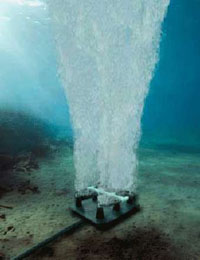
Non-pressure water aeration or open aeration is a method that does not require a pressurized water supply and therefore a closed tank. This method is suitable for treating large volumes of wastewater. A water aeration compressor(screw or rotary blower) delivers compressed air through pipes that end in an air diffuser. The air diffuser ensures better oxygenation of the water, as the compressed air flow is broken up into a whole “cloud”.
Example of selection of a blower for aeration
The oxygen concentration required for effective iron removal is (according to the stoichiometric reaction) at least 15% by weight of the iron content, and about 30% of the manganese content. It is easy to calculate, for example, that if the Fe content is 5 mg/L and the Mn content is 0.7 mg/L, the oxygen concentration in the water should be at least 1 mg/L.
How does this help in practice? For example, in ozonation plants, ozone aeration disinfects drinking water; in biological wastewater treatment facilities, aeration ensures the vital activity of bacteria that purify water. As a rule, aeration is carried out with the help of blowers – machines that compress and supply air to air tanks (water tanks).
Blowers with a volume capacity of 7 to 8000 m3/h are the basis of aeration systems in both small households and large municipal wastewater treatment plants for thousands of residents. The operating pressure difference is usually 0.25 – 0.8 bar (i.e. 250 – 800 mbar). In case of similar operating parameters, the discharge units are also used for backwashing filters, in drinking water treatment plants or for blowing sand traps in wastewater treatment plants.
An example of a completed project
A good example of how Robuschi blowers are used for aeration is described in the report on the completed project at the biological sewage treatment plant of Teplovodoservice. A Robuschi EL 35/2P blower is now used there to aeration 4000m3 of wastewater. Technical details can be found at /projects/vozduhoduvki-robuschi-dlya-kp-teplovodoservis
We will not consider more primitive methods of mechanical aeration due to their low efficiency.
Chemical aeration
Chemical aeration of water is carried out through the use of various peroxides, which, when added to water, react with the active release of oxygen. The disadvantages of this method of water treatment include the difficulty in determining the exact concentration of active substances and the increased danger of working with reagents.
Thus, potassium permanganate has a 2nd hazard class. Personal protective equipment should be worn when working with it, and exceeding its concentration is dangerous to human health. Moreover, as a strong oxidizing agent, it can react with other reagents and cause a fire.
Vapors of another reagent, hydrogen peroxide, can cause burns to the mucous membranes and respiratory tract. The safest of the reagents is calcium peroxide, which has a hazard class 4 and is generally safe for humans.
Biological aeration
Biological aeration of water is carried out using phytoplankton and various beneficial bacteria. At first glance, this may seem like an “environmentally friendly” solution for water purification, but it’s not that simple. To stimulate the growth of phytoplankton mass, various mineral additives and fertilizers have to be used, which in itself can harm the ecosystem. The second method, which is safer, is to artificially populate water bodies with fish that feed on phytoplankton and algae. This will stimulate the ecosystem as a whole. However, if we are talking about heavily polluted water, the productivity of this method is not so high, and moreover, it will depend on the time of year.
Based on the described methods of water treatment, it is safe to say that the mechanical aeration system is the most efficient and cost-effective. Moreover, this technology is highly scalable and can be combined with other water treatment methods.
Dalgakiran Compressor Ukraine not only offers modern compressor equipment for such systems. We are ready to offer a comprehensive approach, providing wastewater treatment plants with pumping equipment, backup power supply systems and service support throughout the entire equipment life cycle.