0800 30 13 77
 0800 30 13 77
 En
En

 Back
BackChillers and fan coils: what they are and how they work
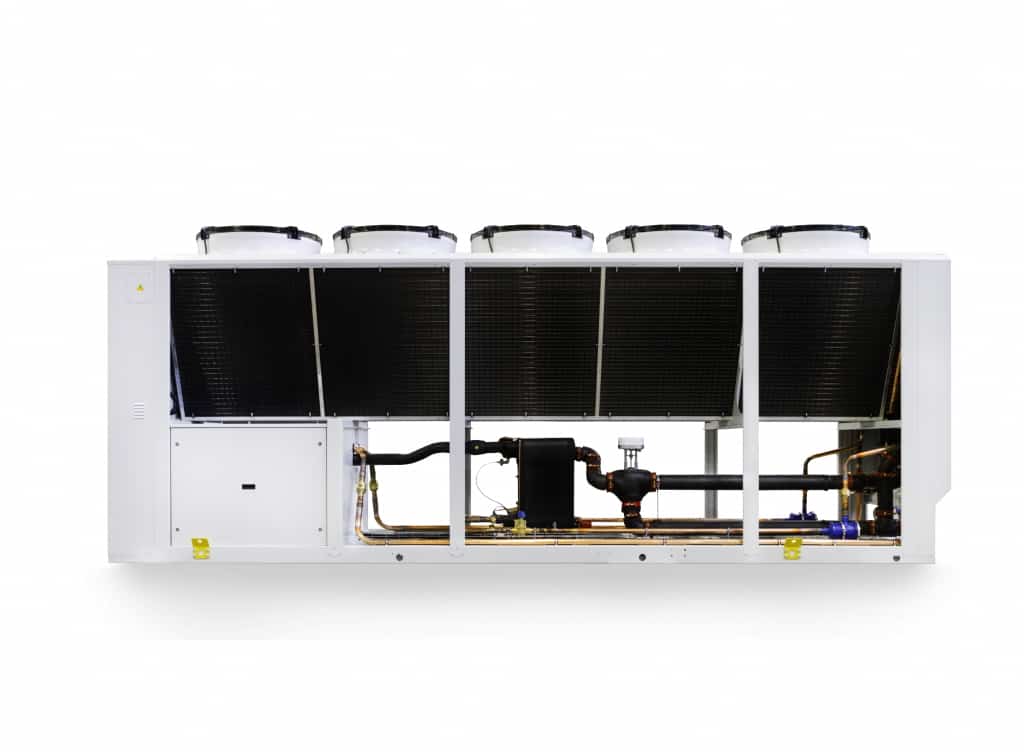
A chiller-fan coil system is best used when you need to cool many rooms in a building or production facility. This system prepares chilled water centrally and distributes it to the areas where it is needed. Thanks to the water circuit, the cooling system is stable, easily scalable and provides precise temperature control.
What are chillers and fan coil units?
A chiller is an autonomous cooler of water or a water-glycol mixture. It removes heat through an evaporator and transfers it to a condenser and then to the outside. Fan coil is the final device in the room with a heat exchanger and a fan. It receives the medium from the chiller and transfers the “cold” to the room air. Together, these units form a single system with local control, where the principle of operation is simple: the chiller prepares the medium, the fan coil delivers it to the desired zone.
Let’s take a look at the key features and benefits of a chiller-fan coil pair:
- high flexibility of zone control and independent temperature control for different rooms;
- good scalability from a small office to a workshop with several branches;
- fewer outdoor units compared to split systems, neat facade;
- stable operation under different loads due to buffer capacity and automation.
All of this explains why such a bundle often wins in projects where the benefits of controllability and stability are important.
Features of the chiller-fan coil system
In this architecture, the production of “cold” is separated from its distribution. This results in uniform costs, lower noise in the premises and predictable energy consumption. Automation maintains the set parameters, and a buffer smooths out compressor starts. For the user, this means reliable cooling without temperature fluctuations.
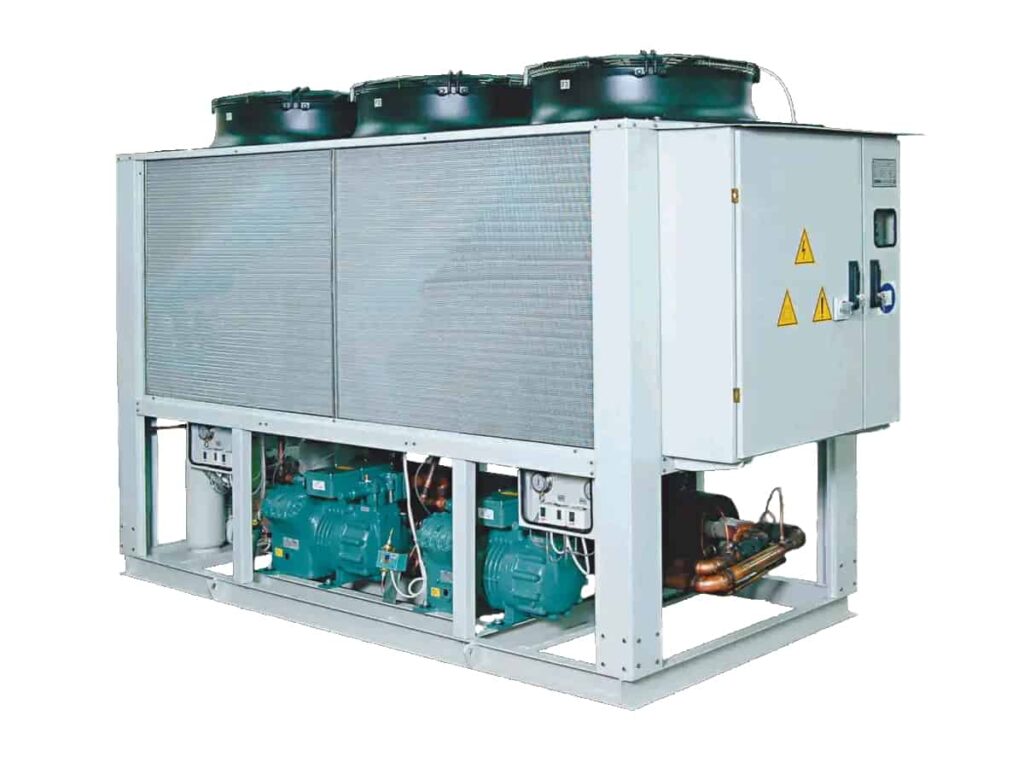
The basic configuration of this system looks like this:
- compressor circuit of the chiller with evaporator and condenser;
- hydraulic module with pumps, expansion tank and buffer;
- distribution hydraulics with balancing valves and filters;
- fan coil units with fan, heat exchanger and control valve.
Together, these elements form a combination of cooling generation and distribution, where it is convenient to perform maintenance and keep acoustics at a comfortable level. In this architecture, the production of “cold” is separated from its distribution, so it is easier to control the temperature in each zone and maintain stable operation under partial loads.
When designing circuits, pay attention to the minimum allowable flow rate through the chiller evaporator – if the load is “split,” the buffer tank evens out the hydraulics and prevents frequent compressor starts. In branched networks with many branches, the primary-secondary scheme (we will discuss it later) with hydraulic separation or a plate heat exchanger works well – it is easier to control the flow rate and pressure drop at consumers.
To control the flow rate in fan coil units, it is convenient to use PICV valves – they provide the required flow rate and reduce the risk of overheating/cooling zones. It is advisable to install a differential pressure sensor on the farthest branch, not in the engine room, so that the frequency drives of the pumps will keep exactly the pressure that the network actually needs.
For a long service life, water treatment is required – filtration, pH and hardness control. In open areas and in the off-season, glycol of the required concentration helps; in the warm season, free cooling is useful – at low outdoor temperatures, the chiller cools the water almost without compressor operation.
Principles of operation of chillers and fan coil units
The chiller ‘s compression cycle works as follows: the compressor compresses the refrigerant, it gives off heat in the condenser and condenses, and boils in the evaporator and takes heat from the water. The controlled electronic thermostat and inverter operate smoothly – this principle of operation ensures economical energy consumption. In a fan coil unit, everything is simpler: the fan drives air through the heat exchanger and quickly brings the room temperature to the set temperature.
Let’s take a look at the key advantages of this technology so that you can quickly assess why the choice of a water scheme is appropriate for offices and industries:
- precise zone control without airflow between rooms;
- long compressor life due to a reduced number of starts;
- convenient maintenance in the engine room, minimal work on the facade;
- lower noise level in the rooms due to the remote source of “cold”.
As a result, the designer gets controllability and adaptability, and the owner gets predictable costs and less risk of downtime.
The difference between a fan coil and a chiller
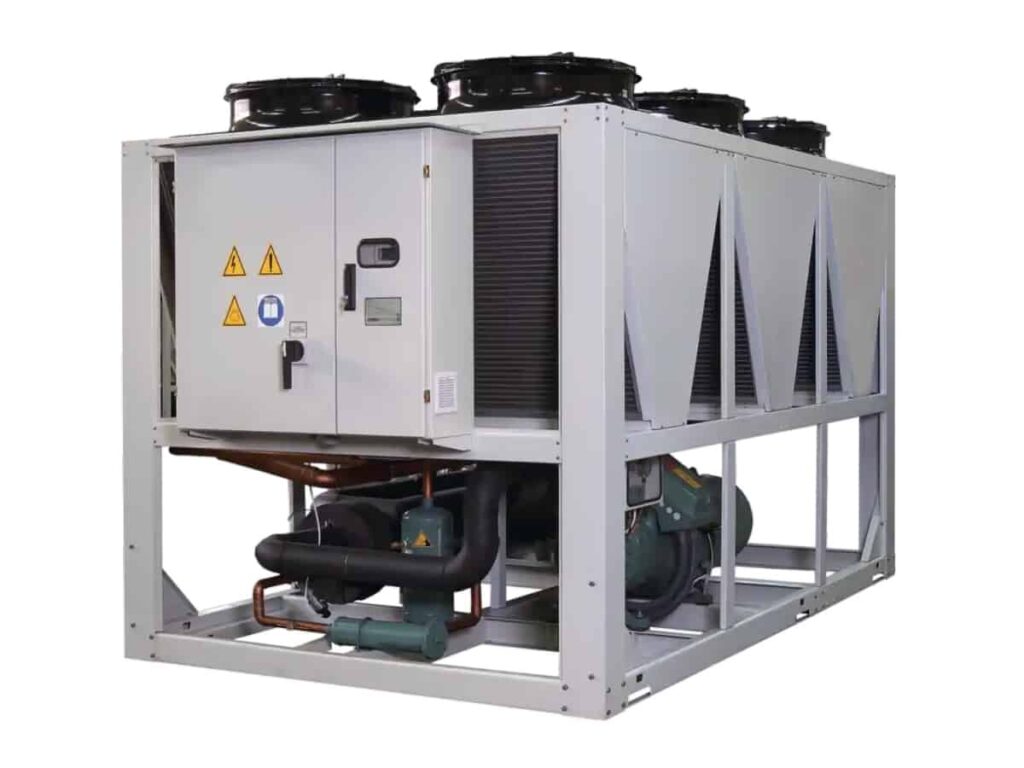
The chiller is the source of “cold” for the entire building, and the fan coil is the final device that transfers this “cold” to the air of a specific zone. It is this combination that makes it possible to scale a building without losing control.
The chiller capacity determines how many kilowatts (or tons of cold) you can actually distribute through the network, while the fan coil capacity determines how quickly and quietly it can cool your room. Adding more fan coils does not increase the overall cooling capacity unless the chiller and pumps are designed for the higher flow rate and temperature drop required.
When choosing a fan coil unit, the type of hydraulics matters. In two-pipe systems, the same coolant can be both cold and warm depending on the season, so transient periods require a well-thought-out schedule. In four-pipe fan coil units, the cooling and heating circuits are separated, so one facade can be cooled and the other heated. This is convenient for buildings with different insolation.
Fan coil units are also responsible for acoustics and indoor air quality. It is advisable to keep the noise level at 30-35 dBA for meeting rooms and hotel rooms, while in corridors it is permissible to have a higher level.
It is also useful to remember a few common mistakes and their consequences:
- Incorrect selection of valves and balancing of branches leads to an overestimated flow rate on nearby devices and “starvation” of distant ones, which is evident from complaints about overheating/cooling.
- Ignoring the dew point in the settings. At low supply temperatures without condensation control, damp spots, fungus and emergency stops occur.
- Underestimation of acoustics and service access. Too high fan speeds, dense ceilings without inspection hatches – and maintenance becomes a problem.
When you clearly separate the roles of the refrigeration source and the end devices, the system operates for a long time and with high quality, and expansions and upgrades are quick and inexpensive.
Types of chillers and fan coil units
Let’s look at the main types of chillers and fan coils:
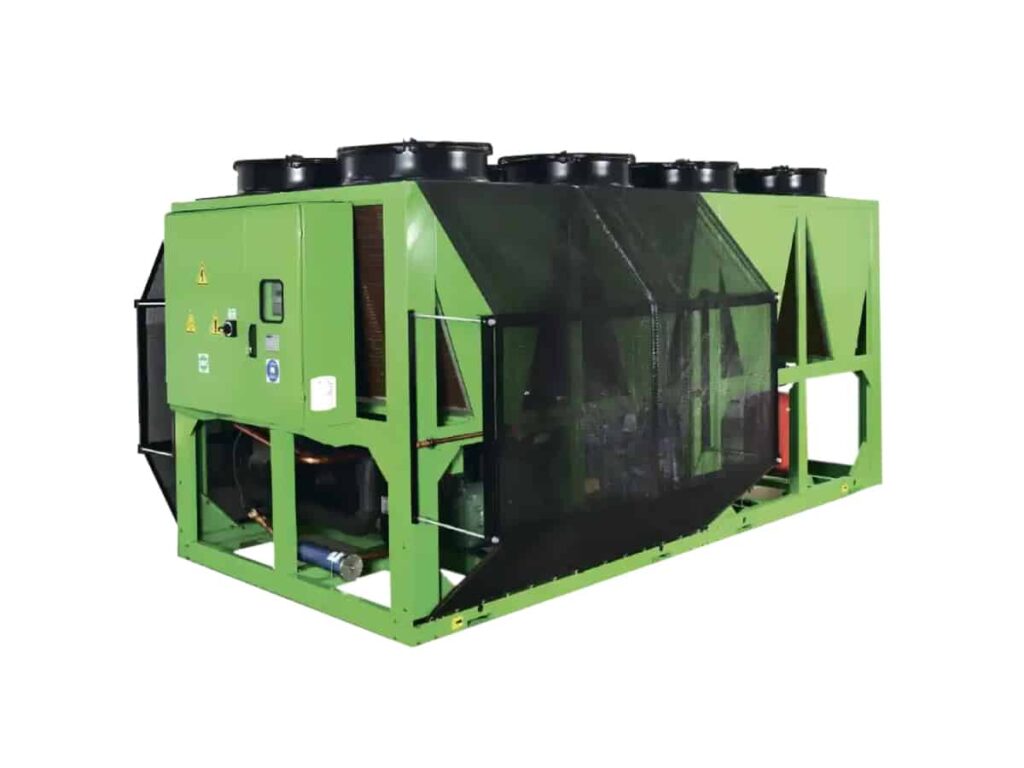
- Air chillers. Easy to install, without a cooling tower, well suited for medium loads. In hot weather, they require proper ventilation of the facility. The advantage is quick start-up and flexible selection in terms of size.
- Water chillers. They work in conjunction with a cooling tower, maintain stable efficiency in summer, and are quieter on the premises. The solution for large facilities with a constant load and an emphasis on environmental friendliness and economy.
- Fan coil units. Wall, floor, cassette, duct – installation can be performed according to the architecture and acoustic requirements. They are available in two-pipe and four-pipe versions. Versions with EC fans (Electronically Commutated) have lower power consumption and smoother control. Fan coil units can have different capacities, which directly affects the efficiency of operation.
Let’s take a look at the practical differences, which will help you choose the right type for your tasks:
- Airborne heat dissipation. Quick installation and autonomy. Suitable for applications where quick implementation is important.
- Water heat removal. Better seasonal economy and quietness. Appropriate for large facilities with uniform operation throughout the year.
- Wall-mounted and floor-standing fan coil units. Convenient for offices and small rooms where neat installation without suspended ceilings is required.
- Cassette and ducted fan coil units. The solution for open-space and corridors where wide air distribution and concealed installation are required.
- EC fans in fan coil units. Lower energy consumption and finer speed control, better acoustic performance.
These guidelines will help you choose the right equipment.
Variants of chiller-fan coil systems
There are several basic wiring schemes:
- Primary-only – when one pumping circuit of the chiller simultaneously pumps consumers. This is a minimum of equipment, but it is more difficult to keep the flow rates on different branches.
- Primary-secondary – a separate chiller circuit and a separate consumer circuit, with a water jet or heat exchanger between them. This design is more stable at facilities with many branches and different modes.
- Variable Primary Flow – variable flow in the primary circuit based on flow and differential pressure signals. This saves energy for the pumps and provides better adaptation to the actual load.
Well-tuned hydraulics equalize temperatures and improve plant safety.
How to choose and combine a chiller with a fan coil unit
Start with the heat balance – separate fixed and variable loads, zones with different schedules and peak hours. Select the supply temperature and the expected return temperature drop – this affects the choice of heat exchangers and pumps. Next, select the types of chillers and fan coil units for acoustics, architecture, and maintenance.
To avoid common mistakes at the selection stage, here is a short practical checklist:
- calculate the reserve of capacity for development, but do not overestimate it;
- Check pressure losses on long branches and circuit balancing;
- Consider condensation drainage, thermal insulation, and access to filters;
- agree on the noise level.
If you follow these steps, the combination of equipment will be balanced, and the overall safety and reliability of the system will increase.
The chiller-fan coil combination is a scalable cooling system for buildings of all classes. A clear operating principle, clear types of equipment and a well-thought-out combination in the hydraulics ensure stable cooling, controllable power and high adaptability. When you consider acoustic, service and maintenance requirements, you get reliable safety and predictable energy consumption.