0800 30 13 77
 0800 30 13 77
 En
En

 Back
BackRefrigerated dehumidifier

At positive ambient temperatures, simple and reliable refrigerated dehumidifiers are widely used, providing a dew point of up to +3°C. They can be found in machine-building enterprises and agricultural processing plants. Wherever packaging, cleaning, welding are required, pneumatic machine drives and pneumatic automation are used – in other words, wherever, according to the technological process, compressed air with a moisture content of no more than 5.95 g/m3 (class 4, according to ISO 8573.1) is used.
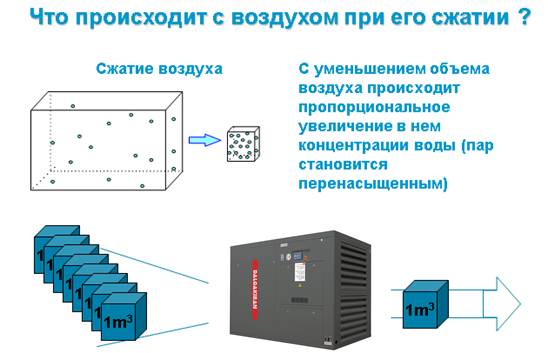
The classic operating cycle of a dehumidifier is as follows: the air entering the refrigerated dehumidifier is fed to the primary heat exchanger, where it is partially cooled by the flow of the outgoing dehumidified air circulating in the heat exchanger. At this stage, they absorb about 60% of the moisture contained in the air.
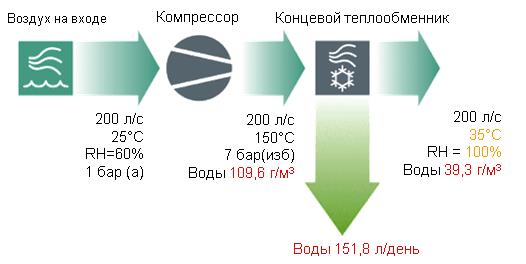
The partially dehumidified air then enters the second heat exchanger, which circulates a special refrigerant (usually R134A or R404A freon). Here, the air is finally cooled to a predetermined temperature and the remaining condensate is removed. At the last stage, the finished dry air with a low temperature is fed into the primary heat exchanger circuit, where it takes heat from the incoming air to the dehumidifier. This rational use of the dehumidified air for preliminary preparation of the incoming air saves up to 40% of the energy consumed by the dehumidifier, and partially heats the outgoing air, preventing condensation on the outer walls of the air ducts behind the dehumidifier.
The condensed moisture is collected in a separator and then discharged from the system via a drain valve. Mixing with water, most of the oil that was introduced into the compressed air during the compressor’s compression is also removed from the compressed air.
Several world-renowned manufacturers produce high-quality and efficient refrigerated dehumidifiers. Among them, the deserved recognition (thanks to innovative technical solutions) is enjoyed by MTA’s Marco Polo dehumidifiers, in which the primary air-to-air heat exchanger, the secondary air-to-refrigerant heat exchanger and the condensate separator are combined into a compact module, which significantly reduces the weight and dimensions of the dehumidifier. “The dew point is monitored by a special sensor, and the evaporator of the refrigeration unit is protected against icing by a by-pass system included in the refrigeration compressor circuit. In addition, the inter-wall space of the outer casing of the dehumidifier is filled with a cold accumulator (thermomass) – specially prepared sand that smooths out peak thermal loads on the system.
Patented GTS heat exchanger
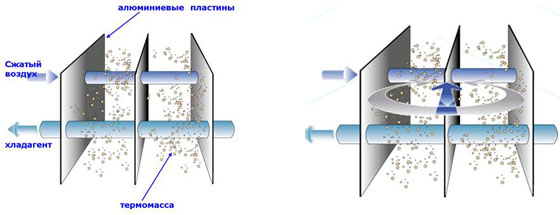
The heat exchanger itself has a patented plate and tube design. The channels carrying the compressed air and refrigerant pass through the thermal masses and are connected to each other by aluminum plates for efficient heat dissipation. When operating at full load, the air is cooled mainly through the plates. At partial load (the main mode of operation of the cooler), the required amount of heat is removed from the compressed air, and the rest from the thermal mass, the temperature of which is thus reduced “in reserve”. At zero load, the low temperature of the thermal mass allows the dryer to be kept in operation when the refrigeration circuit motor is turned off. Overall, this design saves up to 80% of energy.
The state-of-the-art iDRAIN condensate drainage system installed in MTA dryers coordinates the drainage time with the operation of the cooler. This discharge system guarantees zero compressed air loss during operation, while a specially designed vapor trap ensures efficient moisture removal at low to medium air pressures, which is not possible with centrifugal separators.
Zero-loss condensate drainage system
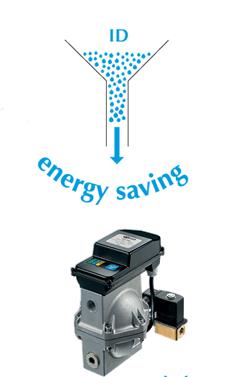
According to many customers, MTA refrigerated coolers are among the best units on the pneumatic equipment market today.
To summarize, we can confidently state that the main modern refrigerated dehumidifiers have a proven, reliable, time-tested design, compact design and insignificant losses of the dehumidified air pressure. At the same time, they require certain maintenance skills from the personnel when regularly cleaning the condenser surface from dust and dirt.
Following a few general recommendations can further optimize the compressed air treatment process and increase the service life of the dryer:
If the temperature leaving the compressed air compressor exceeds +60°C, it is advisable to install a final cooler directly before the dryer. A cyclone separator that removes droplet moisture and oil from the air will also be useful. And, of course, the system should include at least one filter to prevent solid particles from entering the heat exchangers of the dehumidifier.
If you are planning to buy a refrigerated desiccant dryer, please remember that the technical specifications listed in the reference tables correspond to the nominal operating conditions. To make the right decision, taking into account the requirements of a particular process, please contact our specialists who will help you choose the right dehumidifier for your needs.