0800 30 13 77
 0800 30 13 77
 En
En

 Back
BackHow to choose the right diesel generator for a data center?
Equipment responsible for ensuring the smooth operation of data centers must meet certain requirements and standards. The choice of a diesel generator for a data center begins with determining the required characteristics of the installation according to the following key parameters:
- Power
- Regulation class
- Sketching the load in one step
- Temperature mode of operation
The power of a diesel generator set is a key parameter that will determine the efficiency and uninterrupted power supply of a data center.
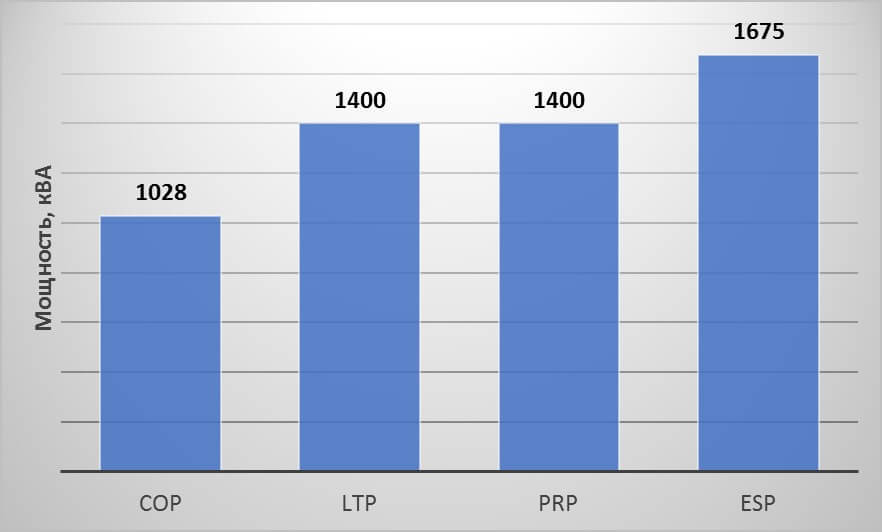
Power modes of operation of the CCGT in accordance with ISO 8528:
- COP (Continuous power) – unlimited operating time at a constant load. Ability to operate at 100% of the power stated in this rating. Example: continuous power supply in parallel with the mains.
- PRP (Prime power) – unlimited operating time at a variable load not exceeding an average of 70% of the declared power. Example: the main power supply in the absence of mains power.
- LTP (Limited time running power) – limited operating time (no more than 500 m/h per year) at constant load. Example: a reference source for peak removal in parallel operation.
- ESP (Emergency standby power) – limited operating time (no more than 200 m/h per year) under variable load. Example: a backup power supply.
An example of a 1675 kVA power plant in different modes:
When choosing an architecture for modern data centers, great attention is paid to ensuring the required level of reliability and fault tolerance of the selected equipment. The diesel generator must be able to deliver the required power at 100% and fulfill the backup task. Therefore, let’s consider the Uptime Institute’s recommendations for Tier III and Tier IV data center requirements.
Based on the document “Data center infrastructure. Tier Standard: Topology “
Power generators are seen as the primary source of power for data centers, while the energy supplier (the central power grid) is seen as an economic alternative. Disturbances in the power grid are not considered as a system failure, but rather as foreseeable operating conditions for which the data center must be prepared. Accordingly, power generators should start automatically and supply power immediately after the loss of external (main) power.
TIER III-IV power generators, along with other additional data center power supply elements, must meet the requirements for simultaneous maintenance and/or fault tolerance when powering the data center.
Electric generators at TIER III or IV should not have any restrictions on the number of hours of continuous operation at the required load. Electric generators with a limited operating time at the required load are only suitable for TIER I or II facilities.
Clause 3.3. Warnings about limiting the operating time of generators (Tier III and Tier IV)
The requirement for unlimited runtime of power generators is necessary to ensure that the installation is able to provide the required amount and continuity of power to the facility. The TIER topology requires that the rated power of power generators that functionally support one of the three operating modes according to ISO 8528-1: continuous, prime, standby, be considered separately, depending on the requirements of a particular case.
а. Diesel generators with a rating / or “in mode” (Сontinuous ) can operate continuously for an unlimited number of hours at a given rated power.
b. Diesel generators with a rating and/or “in mode” (Prime ) can operate for a limited number of hours at a given rated output. This does not meet the requirements of section 2.5 of the document. As stated in ISO 8528-1, the generator capacity for continuous operation should be equal to 70% of the Prime rating. Some manufacturers provide a different level of reduced power (less or more than the standard 70%), at which the generator can operate indefinitely. The manufacturer’s certificate, which determines the ability of the generator to operate in continuous mode (for an unlimited number of hours), is used to determine whether the technical characteristics of the DGU meet the TIER requirements.
c. Standby generators by definition have a limit on the total number of hours of operation per year. This characteristic does not meet the conditions of section 2.5 of the document. Some manufacturers declare a level of reduced rated power at which the generator can operate indefinitely. Compliance with the TIER standards is determined on the basis of the manufacturer’s certificate, which determines the ability of the generator to operate continuously for an unlimited number of hours.
Bottom line: According to the Uptime Institute (UI) requirements for TIER III and TIER IV data centers, generators with Continuous operation are suitable for their continuous and uninterrupted power supply.
What is a DCC rating?
DCC-rating (Data Center Continuous) defines the requirements for diesel generator sets in the Continuous power mode, designed for unlimited duration of operation without restrictions on the average variable or constant load. The use of DCC-rating for the selection of a diesel generator set ensures that the diesel generator set will operate at the limit of the specified power rating for an unlimited amount of time. The DCC rating greatly simplifies the process of data center engineering design and facilitates the passage of Uptime Institute certification.
Recommendations for choosing a DGU by power parameter for TIER III and TIER IV data centers
- The diesel generator must comply with the Continuous power mode at 100%.
- The capacity of the diesel generator set for continuous operation can be selected – 70% of the Prime mode of the rated capacity of the plant or more in agreement with the Uptime Institute.
- The DGU must comply with the DCC rating (Data Center Continuous) agreed with the Uptime Institute.
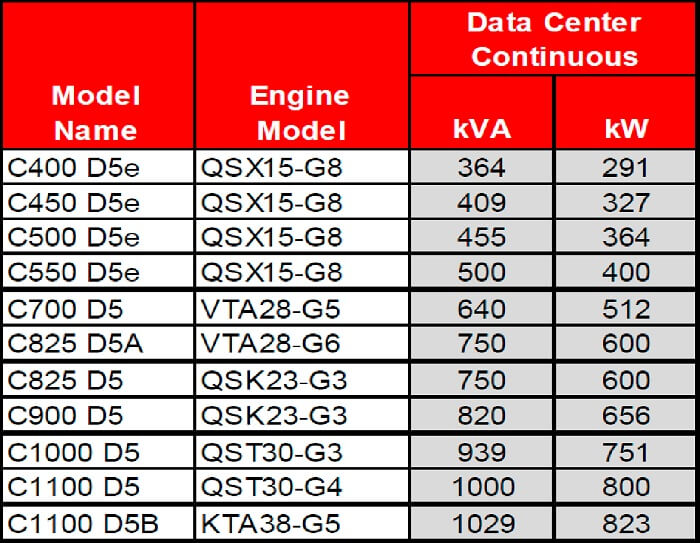
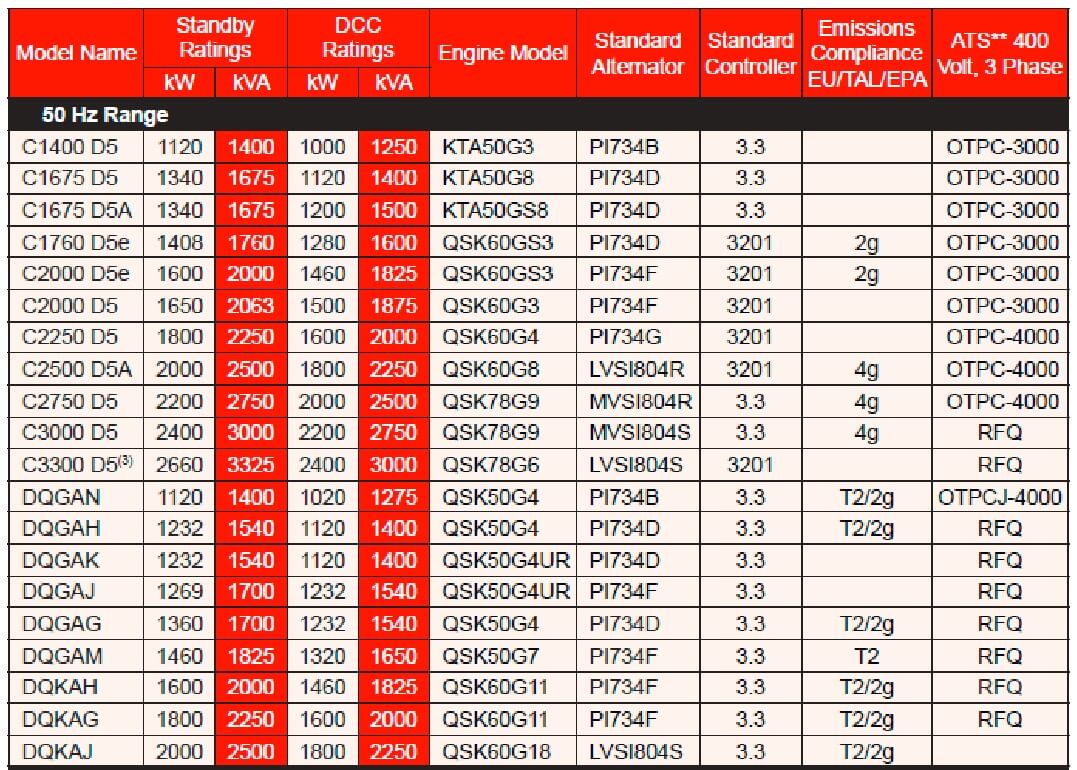
The above recommendations cover the power range of Cummins diesel generators from 400 kVA to 3300 kVA, suitable for power supply of TIER III and TIER IV data centers. The Cummins DCC rating (Data Center Continuous) corresponds to the Prime Rating mode.
DCC-rating (Data Center Continuous) for Cummins 400-1100 kVA gensets:
DCC-rating (Data Center Continuous) for Cummins 1100-3000 kVA diesel generator sets:
Example: a data center needs 5 MW of backup power. The redundancy is provided by five stations operating in parallel
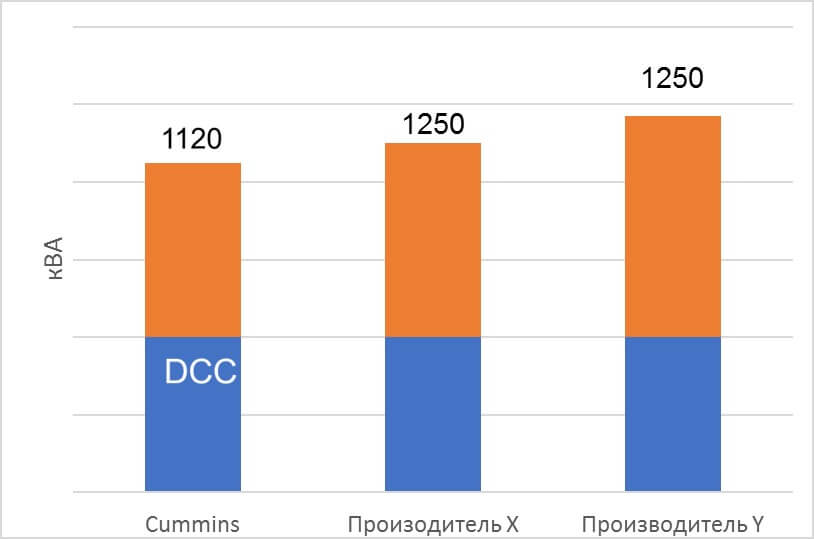
Using 5 Cummins power plants of the C1400D5 model (ESP = 1120 kW, DCC = 1000 kW), the power savings will range from 650 to 1540 kW.
Different manufacturers take the load power per step differently, for example:
- Producer X – takes 40% – 50% of the capacity
- Producer Y – takes 60% – 70% of the capacity
- Producer Z – takes 85% of the capacity
- Cummins – takes 100% of the power in one step
The ability to accept 100% of the load in one step and ensure minimal voltage and frequency sag makes it possible to meet the DCC rating.
Regulation class
NThe generator’s rated power is calculated to meet the maximum demand of electrical loads requiring backup power. The load factor is the ratio of the average load to the generator’s rated power. Generator ratings can be specified in kW or kVA (MW or MVA for larger systems). If the value is given in kW or MW, it is assumed that the power factor is 0.8 and therefore these values are lower than the kVA or MVA values.
There are four classes of regulation that determine the quality of a diesel generator’s power in terms of stability, voltage and continuity. The higher the class, the stricter the requirements:
- Class G1 – generators for general-purpose loads. Example: general purpose systems (lighting and other simple electrical loads).
- Class G2 – power generators for systems where the standards are not critical and temporary deviations are allowed. Examples: lighting systems; pumps, fans and elevators.
- Class G3 – power generators for systems where the requirements for power supply characteristics are moderately stringent. Example: telecommunication equipment and thyristor control systems: thyristor loads and current rectifiers must not distort the sinusoidal voltage curve.
- Class G4 – power generators for systems where the requirements for power supply characteristics are stringent. Example: data processing or computer systems.
Frequency and voltage drops:
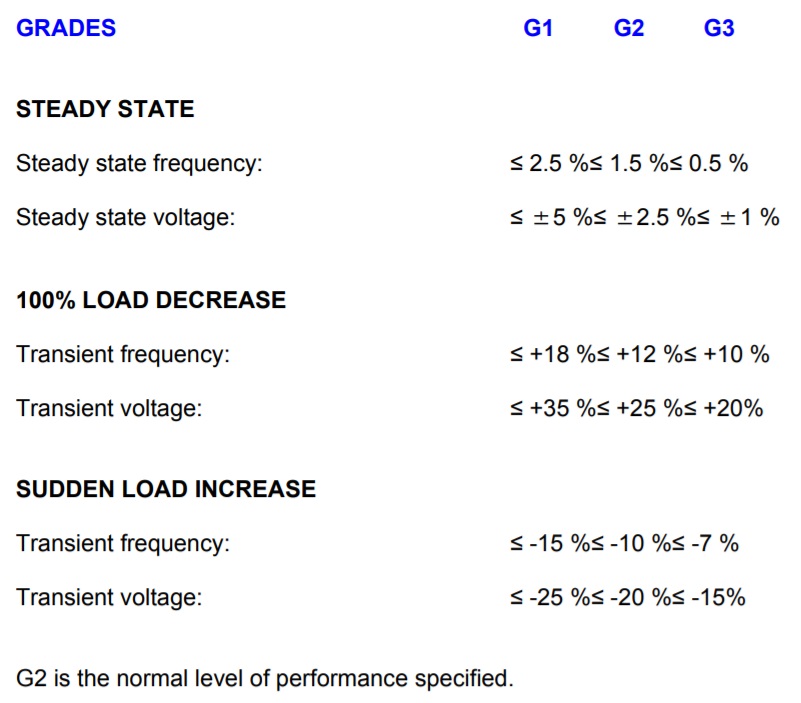
Bottom line: for a data center, the control class of an electric generator must be at least G2.
Temperature conditions
In addition to the above, an important criterion for choosing a diesel generator is the temperature regime. It is necessary to take into account the maximum possible temperature in the region where the data center will be located. Depending on this, diesel generators are equipped with appropriate cooling radiators. As a rule, radiators for 40, 45 or 50 degrees Celsius.
When choosing a radiator, it is important to take into account the altitude above sea level, which also affects the possible power drop.
Materials for download:
Presentation “Not all generators are equally useful or choosing a power plant for a data center”
Presentation “Data center infrastructure – Tier Standard Topology”
Author: Alexander Popov, Project Manager of the Diesel Generator Division