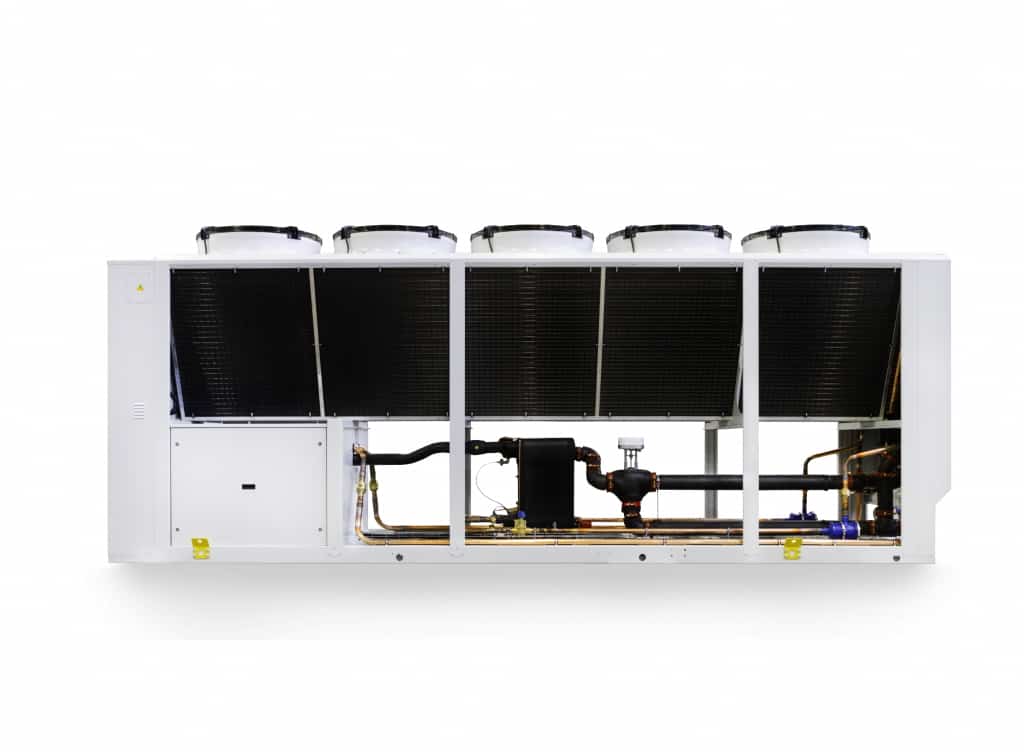
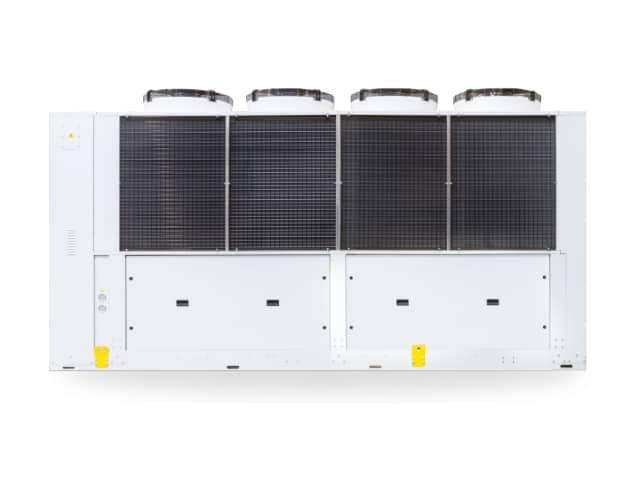
An air-cooled condenser chiller works on the basis of a reverse refrigeration machine cycle. It uses a compressor, condenser, evaporator, and expansion device to create chilled water, which is then circulated through the refrigeration system.
How an air-cooled chiller works
The compressor compresses the refrigerant, increasing its temperature and pressure.
The hot gas enters the condenser, which is cooled by ambient air as it passes through the fan blades. The cooling of the gas causes it to condense into a liquid, removing heat to the outside.
The liquid refrigerant enters an expansion device where the pressure is reduced and it turns into cold, low-temperature vapor.
The cold steam passes through the evaporator, where it absorbs heat from the water circulating through the cooling system and turns back into gas.
Freon then flows back into the cooling system, where it circulates through pipes and heat exchangers.
The process is repeated until the system needs cooling.
In air-cooled condenser chillers, fans move the air that cools the condenser. This allows the chiller to operate in environments where water or other coolants cannot be used to cool the condenser.
Advantages of air-cooled chillers
Initial investment
Chillers of this type are cheaper than their water-cooled counterparts. In addition, they do not require more complex preparation of the infrastructure for operation and additional equipment for the placement of this refrigeration equipment.
Efficiency of work
They consume less electricity, which reduces costs.
They do not require additional water for cooling, which means that there is no need for an additional cooling system.
Easier installation
Air-cooled chillers are easier and faster to install than condenser water-cooled units. The reason is simple – it does not require additional water cooling equipment and associated piping.
Lower production space requirements
No space is required for additional equipment, as the condenser is cooled by air. This makes it an ideal choice for technical rooms with limited space.
Service life
Although this indicator depends more on the equipment manufacturer, operating conditions, and maintenance, it should also be taken into account. Air-cooled chillers are less susceptible to corrosion because they do not use water in their operation. In addition, the absence of water use eliminates technical issues with the wear and tear of pipelines, valves, and nozzles from poor quality water (due to their absence). This means they can have a longer service life and consume fewer resources for maintenance and replacement.
Disadvantages of air-cooled chillers
The main disadvantage of such equipment is the drop in its efficiency depending on the air temperature. The smaller the temperature difference (Δ T), the less cooling capacity is available. It should be borne in mind that an air-cooled chiller may be less efficient, especially in hot weather when the air temperature is higher.
A secondary disadvantage is the noise level during operation. However, it directly depends on the type of fans, a particular manufacturer, and model range.
Types of fans used in chillers
Different types of fans can be used for air-cooled condenser chillers, which differ in design and performance. Below are some of the most common fan types and their features:
Axial fans are the most common types of fans used in air-cooled chillers. They are usually mounted in a vertical position and can be available with straight or curved blades. Axial fans have high performance but can consume more energy.
Centrifugal fans have a radial airflow direction and are usually installed in a horizontal position. They have higher performance and can consume less energy than axial fans, but can be noisier.
It is also worth considering not only the design of the fan blades, but also the type of electric motors and their power control. Modern energy efficiency requirements require the flexibility to adjust the fan speed depending on the chiller’s operating mode.
EC fans use an electronically commutated motor that allows you to adjust the speed of the blades and control energy consumption. They have high performance and can be more economical to operate.
Inverter fans are used to automatically adjust the speed of the blades depending on the ambient temperature and the load on the chiller. They can be more efficient and economical to use than other types of fans.
Axial fans in chillers
Axial fans in air-cooled condenser chillers have their advantages and disadvantages.
Advantages:
Consume less electricity than radial fans with the same airflow.
They can be installed directly on the condenser, making the system more compact and saving space.
They have a low noise level, so they can be used in areas where it is important to reduce noise.
Disadvantages:
Inefficiency when working with high pressure, which can lead to a loss of productivity.
Low draft coefficient, they cannot always create a strong enough airflow to cool the condenser.
Size restrictions do not always allow them to be used in systems with large air volumes.
The installation of axial fans requires special knowledge and skills, so it is better to entrust their installation to specialists.
Centrifugal fans in chillers
Advantages:
They have high performance when working with high pressure, which allows you to create a sufficiently strong air flow to cool the condenser.
They can be used in a variety of air cooling systems, as they can operate in both low and high pressure conditions.
They can operate at different speeds, which allows them to be more flexible and efficient in different conditions.
Disadvantages:
They are heavier and larger, which affects the dimensions of the chiller itself.
The noise level is higher than axial fans.
Power consumption is higher than axial fans.
Maintenance, repair and replacement are more expensive than axial fans.
Need a consultation?
Fill out the form and we will call you.
Your region
Request a call
Thank you, your request has been sent. A manager will contact you shortly.
 0800 30 13 77
 0800 30 13 77
 En
En