0800 30 13 77
 0800 30 13 77
 En
En

 Back
BackNitrogen use in the food industry
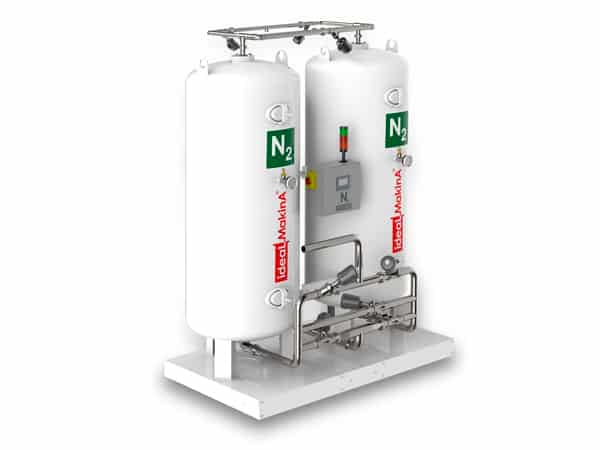
Consistent quality and long-term preservation of products is one of the main challenges for the modern food industry. Among the technologies that help to achieve this, nitrogen has a special place. Thanks to its physical and chemical properties, it is used in both gaseous and liquid form for packaging, cooling and transportation of food.
Characteristics of nitrogen that make it useful in the food industry
The main advantage of nitrogen is that it is an inert gas. It does not react chemically with food, nor does it change its taste or odor. Other important characteristics:
- lack of color and odor;
- low boiling point in the liquid state;
- the ability to displace oxygen from the environment;
- safety for humans when used correctly.
It is thanks to these properties that nitrogen is widely used in the food industry.
The use of nitrogen in food packaging
Packaging using nitrogen gas extends the shelf life of goods. The principle is simple: the oxygen inside the package is replaced by an inert environment in which bacteria and fungi grow much more slowly.
This method is widely used for packaging:
- coffee and tea;
- snacks, chips, nuts;
- confectionery products;
- meat and dairy products.
Manufacturers are able to deliver food to consumers without losing quality. To do this, nitrogen is stored in a special cylinder or tank and fed to the packaging line.
Liquid nitrogen for freezing food
Another common technology is shock freezing using liquid nitrogen. Its boiling point is -195.8 °C, so contact with the product provides instant cooling.
The advantages of this method are as follows:
- formation of small ice crystals that do not damage the cellular structure;
- preserving the natural taste, color and texture;
- maintaining the weight of the products after defrosting.
This method is used for seafood, berries, fruit, meat and prepared foods. In production facilities, liquid nitrogen is stored in a large tank and then fed to the appropriate units.
Why nitrogen is safe and effective for the food industry
The use of nitrogen in the food industry is considered completely safe. It is part of the air we breathe and is not toxic. The main thing is to follow the correct operating and maintenance procedures for nitrogen and oxygen cylinders, tanks, and generators to avoid risks in production.
The effectiveness of the application is confirmed by decades of practice:
- products retain their freshness longer;
- food losses are reduced;
- businesses are able to deliver quality food over long distances.
Inert gas in the form of gaseous or liquid nitrogen has become an integral part of modern food processing technology, as it provides producers with stability and consumers with safe and fresh products.