0800 30 13 77
 0800 30 13 77
 En
En

 Back
BackChiller. How it works and the benefits of using it
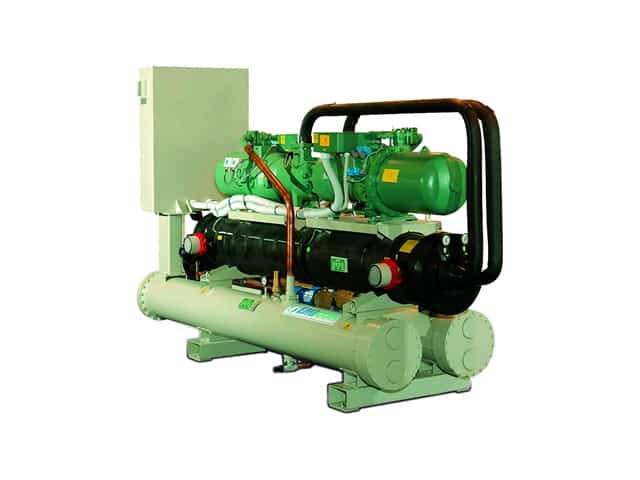
If a workshop, data center, or business center needs to cool water or other liquid medium stably, a chiller is usually installed. This is an autonomous cooler that removes excess heat from equipment, rooms, or technological processes and maintains the set temperature of the medium in the pipeline. In industry, such systems operate around the clock, so it’s not just the kilowatts of cooling that matter, but also energy efficiency, reliability, easy maintenance, and seamless integration into the overall water or air cooling system.
We recommend that you familiarize yourself with our range of cooling systems, which is easy to navigate by class and performance.
What is a chiller and what is it used for?
A chiller is an autonomous industrial cooler that prepares and maintains a set temperature of water or other liquid medium, after which it is circulated through pipelines to consumers. In a typical project, the chiller maintains a range of approximately 5 to 20 °C (lower values are possible for glycol) and stabilizes the temperature with sufficient accuracy for processes and air conditioning systems. Thanks to a separate hydraulic module (pump, buffer tank, valves), the chilled water is evenly distributed between all circuits – from ventilated fan coils to machine heat exchangers.
The task of a chiller is to remove excess heat where it is generated a lot and constantly. In buildings, these are office centers, hotels, shopping malls, and medical facilities – where the chiller supplies cold water to fan coils and air handling units. In production, it stabilizes molds in plastic molding, cools extrusion and packaging lines, and maintains the operation of printing and printing machines, laser and welding equipment.
What components does the device consist of
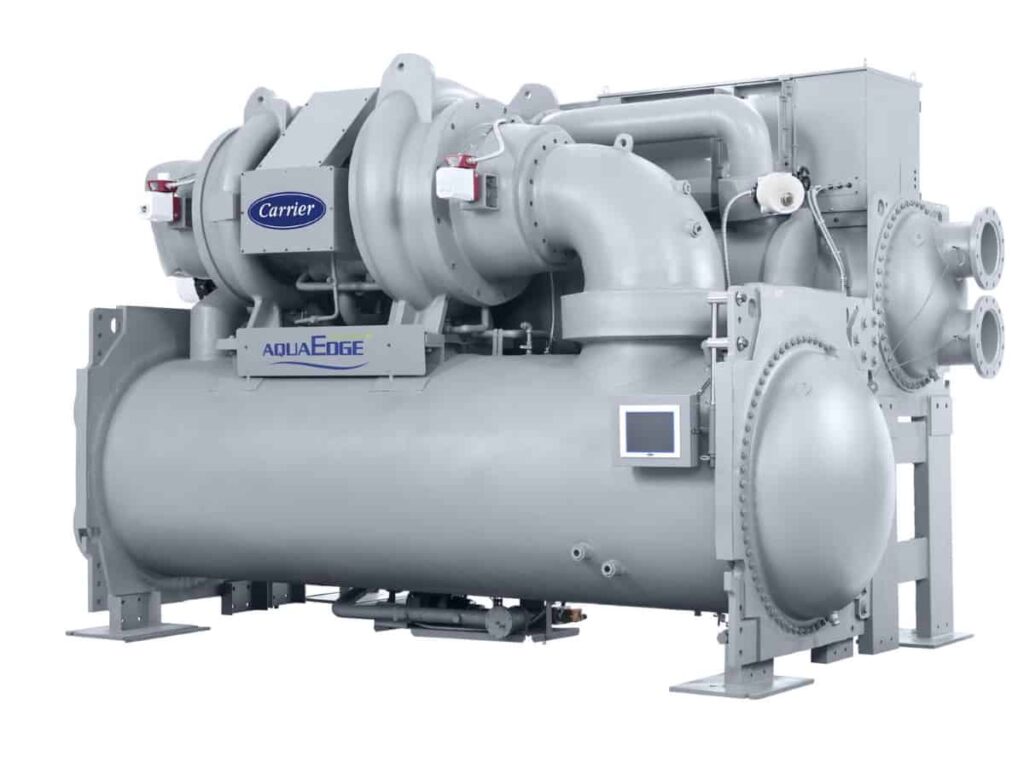
In order to quickly understand the data sheet and the schematic, it is useful to know the basic components. The list is short, but it contains all the logic of the device and its operation:
- Compressor. It compresses the refrigerant, increases its pressure and temperature, and sets the performance. There are piston, scroll and screw types – each has its own power and mode.
- Capacitor. Here, the hot gas gives off heat and turns into a liquid. The condenser can be an air condenser with fans or a water condenser that removes heat to a cooling tower or other water circuit.
- Evaporator. The liquid refrigerant boils and takes heat from the water or solution, which is where the “cold” is formed.
- Expansion valve (TRV/ERV). Doses the refrigerant between the condenser and evaporator, maintains stable superheat and ensures correct cycle operation.
- Hydraulic module. Pump, buffer tank, valves, sensors – they are responsible for circulation and pressure in the hydraulic circuit.
- Automation. Controller, temperature and pressure sensors, protection and dispatch interfaces – stability and efficiency depend on them.
The compressor pumps the “coolant of cold”, the condenser releases heat to the outside, the evaporator takes it from the water, the hydraulic module distributes this “cold” to consumers, and the automation keeps everything within the specified limits.
How the chiller works
The cycle works as follows: the refrigerant is compressed in the compressor, gives off heat in the condenser and becomes a liquid, enters the evaporator through the throttle, where it evaporates again and takes heat from the water. Then the circuit repeats.
In practice, it looks like this: a sensor in the return line detects an increase in temperature, the controller connects the compressor and, if necessary, additional stages or inverter mode, the water in the evaporator is cooled, the hydraulic module pumps drive it to consumers, and fans or a cooling tower remove heat to the outside environment. As soon as the set temperature is reached, the automation reduces the power or shuts down some of the stages. A well-tuned chiller operates without temperature swings, with minimal shutdowns.
Water or air cooling technologies in chiller systems
In a chiller, it’s not just the “refrigeration” part that’s important, but also where you remove the heat. There are two basic ways – into the air or into the water, and a number of technologies that increase efficiency in different conditions. Let’s take a look at how this works in practice, what components are involved, and what to check when selecting.
Air chillers have a condenser with fans and release heat directly to the environment. This is a compact solution without a separate cooling tower and is much easier to install on the roof or outside the building. The compressor compresses the refrigerant, which is cooled in the condenser by the air flow from the fans and changes to a liquid state. Then, through an expansion valve, it enters the evaporator, where it removes heat from the water and cools it to the set temperature.
Water chillers transfer heat to a closed condenser circuit, which then transfers heat to a cooling tower or other heat exchanger. This arrangement is more stable in terms of condensing temperatures and quieter in the chiller area. The condenser is cooled by water from the cooling tower. The lower temperature of this water makes it easier for the compressor to operate and increases seasonal energy efficiency.
Free cooling is also worth mentioning. This is a way to cool water without running the compressor when it is cool outside. The system either turns on a separate dry cooler or reorients the flows in the air chiller through an additional heat exchanger. This is useful in the off-season and in winter, especially for data centers, industries with constant loads, and buildings with a high demand for “cold” at night.
Adiabatic cooling is also practiced: the air is humidified and cooled before the condenser by evaporating water. In hot weather, this reduces the temperature of the heat exchanger inlet and facilitates the operation of the compressor. The advantages of this method include higher seasonal efficiency in peak heat and fewer power cuts due to condenser overheating.
The difference between water and air cooled chillers
The difference is determined by where the chiller discharges the heat from the condenser: into the air via fans or into a water circuit with a cooling tower. This determines the initial investment, energy efficiency, noise, space and maintenance requirements, as well as how the system behaves in the heat and off-season.
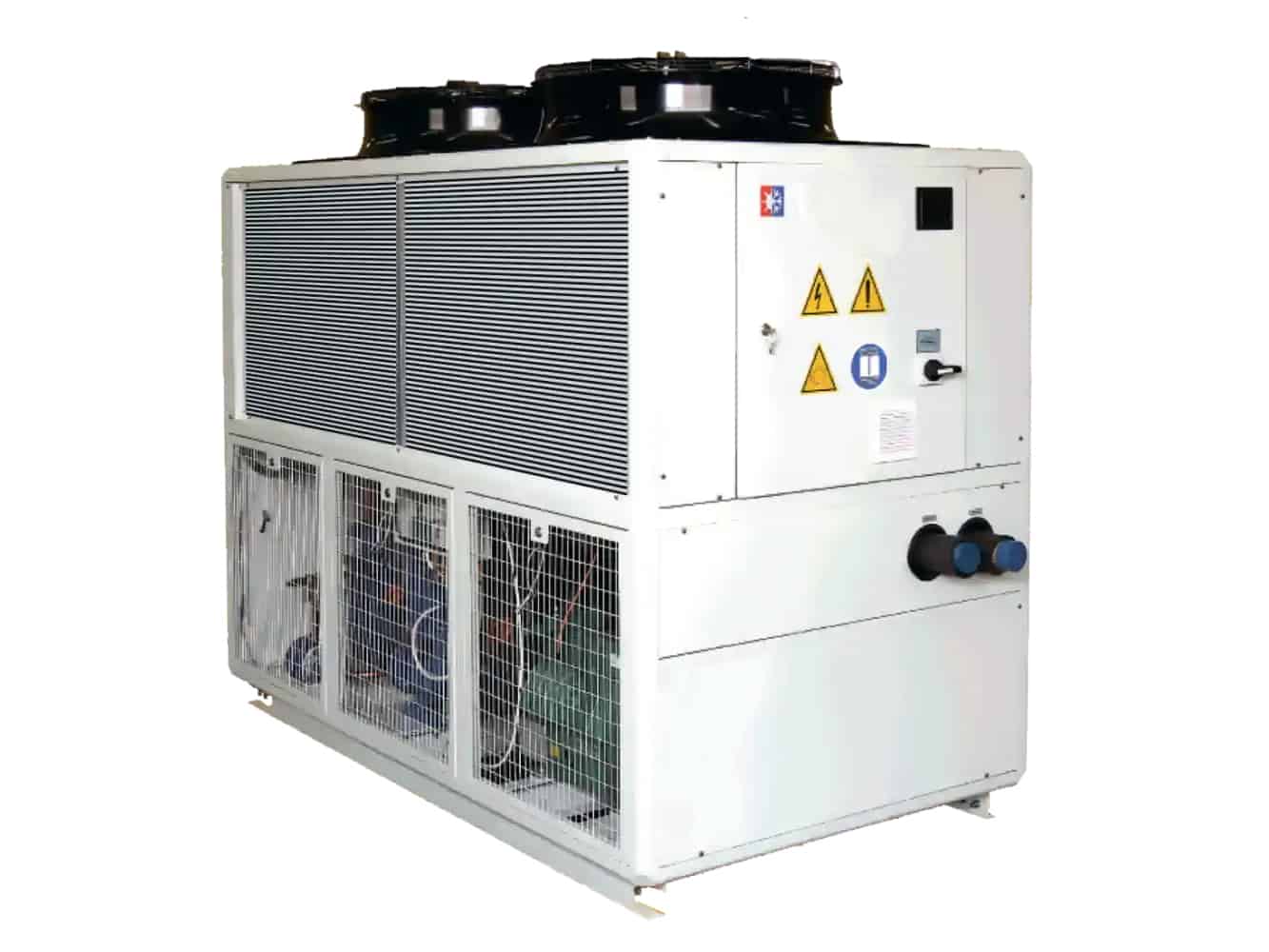
The air cooling system uses a self-contained industrial chiller. An external condenser with fans releases heat directly to the atmosphere. Installation is simple, with no cooling tower, water treatment or separate condenser pumping station required. The typical scheme is as follows: the compressor compresses the refrigerant, it gives off heat in the air condenser and condenses, then enters the evaporator through the expansion valve, where it cools the water.
Advantages – quick start-up, lower start-up costs and relatively easy maintenance. Limitations – higher condensation temperature in hot weather, so seasonal efficiency is lower and noise level in the installation area is higher.
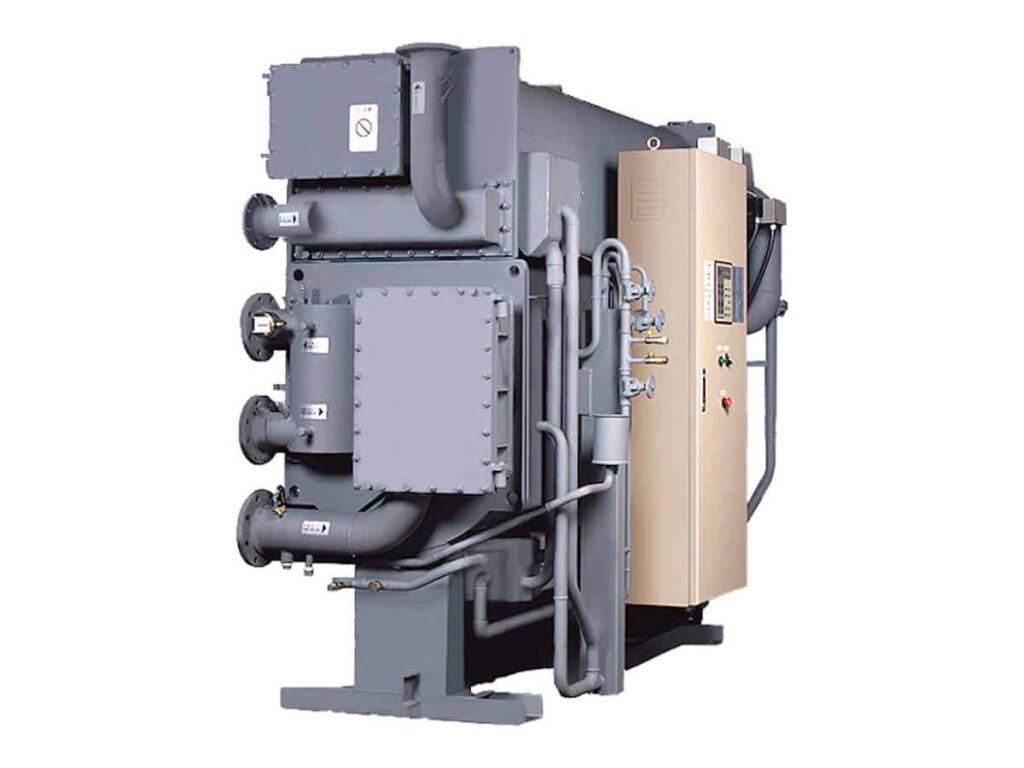
With water cooling, the chiller releases heat to the water circuit, which then releases heat to a cooling tower or other heat exchanger. Due to the lower water temperature at the condenser inlet, the compressor runs more easily, resulting in increased seasonal energy efficiency and reduced noise.
Among its advantages are stable parameters in the heat, better EER/SEER over a long distance, and flexibility in equipment placement (the chiller can be placed inside the technical room). The disadvantages are higher costs (cooling tower, pipelines, condenser circuit pumps, water treatment, regular inspection of hydraulics, etc.) This approach is appropriate for large facilities with constant heat generation, including those where silence is important near work areas.
What to choose:
- If you need a quick start and ease of maintenance is important, it is better to choose an air chiller. It is more compact as a device and can be quickly mounted on the roof or outside the building.
- If you have continuous loads and a high electricity price, the water option usually wins out in terms of savings. The lower condensing temperature results in tangible kWh savings, fewer starts and less thermal swings. You can find specific models in our catalog of water-cooled condenser chillers, where you can easily compare performance, dimensions and hydraulic requirements.
- For climates with a long off-season, consider free-cooling – the water can be cooled part of the year without running the compressor. This works with both air and water circuits.
Air chillers are often used in medium-sized office and shopping centers, individual production halls, and laboratories where quick installation and autonomy are important. Water chillers are installed in large business centers, hospitals, factories, and data centers, where the “more expensive” infrastructure pays off with lower energy costs and the possibility of centralized backup.
For air machines, clean parts and proper airflow are important, while for water machines, water quality and drainage are important. In both cases, the stability is maintained by automation, which is responsible for smoothly adjusting performance, prioritizing circuits, and protecting against excessive pressures and temperatures.
The main advantages of using a chiller
A chiller is a controlled “cold pump” that makes processes stable and predictable. To ensure that the benefits are not only tangible on paper, keep real-world scenarios in mind:
- Stable media temperature. Product quality and indoor comfort depend on the temperature of the water being kept at a constant level, and chiller automation is responsible for this.
- Energy efficiency in the season. It’s not the immediate energy efficiency factor that matters, but the seasonal indicators, taking into account the weather, nighttime load reductions, partial power modes, and the possibility of free-cooking.
- Scalability and service. Modules are easy to combine and standardized components simplify maintenance. In the event of a repair, one circuit can be taken out of service without shutting down the system.
- Integration with ventilation and BMS. Clear data exchange with air handling units, fan coils, pump groups and dispatch ensures stability and saves energy.
- Flexibility in applications. Centralized water cooling is often the way to go where overheating is detrimental to quality or reliability.
In order not to make a mistake with your choice, you should follow the checklist below:
- Start with the heat balance of the facility, and separate the fixed and variable loads;
- Check the installation conditions – space, noise, access to outside air or to the water circuit, service passages;
- Select the hydraulic module – pumps, buffer tank, drainage, etc;
- think about automation – priorities for switching on circuits, protections, integration into BMS;
- take care of water treatment – quality of fill, corrosion inhibitors in glycol, filtration, regular monitoring;
- choose the type of compressor for the mode – in large capacities, screw compressors are often used, in compact ones, piston compressors are used.
Each point should be completed at the design stage – it is cheaper than redesigning hydraulics or changing automation after launch.